


Company hierarchy data maps who legally owns whom across a corporate family, from ultimate parent down to subsidiaries and branches. For sales and marketing teams, it is the key to finding true budget authority, consolidating fragmented accounts, and avoiding duplicate outreach. The practical next step: pull a parent-level identifier, such as an LEI or registry number, before you build your next account list.
TL;DR:
- Using external identifiers like LEI or registry numbers ensures hierarchy data remains accurate through reorganizations and rebranding.
- Combining multiple sources such as LEI, national registries, and commercial filings improves coverage and reliability, especially across different jurisdictions.
- Regularly updating hierarchy data with staged, approval-guarded processes prevents outdated or incorrect mappings from causing account and deal errors.
- Mapping from a parent level enhances account segmentation, forecasting, and routing accuracy, reducing duplicate outreach and fragmented sales efforts.
- Tracking parent-level coverage as a key performance indicator helps teams identify ownership changes before they impact renewals or sales pipelines.
Table of Contents
- What company hierarchy data maps: terms and structure
- Why hierarchy data matters for sales, marketing and research
- Key data sources: what to rely on and how they differ
- Integrating and governing hierarchy data in CRM and RevOps
- Tactical best practices for outreach, routing and reporting
- Practical governance matters more than perfect coverage
- Cleanlist: data and enrichment built for hierarchy-driven programs
- FAQ
- Sources
What company hierarchy data maps: terms and structure
Company hierarchy data describes the legal and financial relationships that connect entities within a corporate family. An ultimate parent sits at the top of the ownership chain, a direct parent owns a subsidiary outright or by majority stake, and subsidiaries, branches, and divisions sit below, each with different degrees of legal independence. A subsidiary is typically its own legal entity, while a branch or division usually is not.
One confusion trips up most RevOps teams: ownership data and org-chart data answer different questions. Ownership tells you who controls the entity financially and legally. An org chart tells you who reports to whom inside daily operations. A regional vice president may report to a country general manager on the org chart, while the entity itself rolls up to an ultimate parent three jurisdictions away on the ownership map. Treating these as the same dataset causes account mapping errors that compound over time.
Stable identifiers solve much of this. Matching companies by name string alone produces duplicates and false merges, because legal names change, get abbreviated, or appear differently across registries. Identifiers built for this purpose avoid that problem:
- Legal Entity Identifier (LEI): a 20-character global code tied to a single legal entity, maintained under international standards.
- National registry numbers: identifiers issued by a country’s corporate registry, often tied to tax or incorporation filings.
- Internal CRM IDs: useful for operational tracking but never a substitute for an external, portable identifier.
Anchoring records to an external identifier rather than a name means your hierarchy survives rebranding, mergers, and reorganizations without breaking.
Why hierarchy data matters for sales, marketing and research
Hierarchy data turns a flat account list into a map of where decisions, budget, and risk actually sit. The payoff shows up across several functions at once:
- Account-based marketing and prioritization: parent-level visibility reveals cross-sell clusters and lets teams rank accounts by total exposure across a corporate family, not just one subsidiary.
- Territory planning and forecasting: roll-up metrics attach subsidiary revenue and pipeline to the correct parent, which keeps quota and forecast numbers from double-counting or undercounting a single buying group.
- Segmentation: hierarchy data helps separate enterprise clusters, multi-brand buyers, and channel partners into segments that reflect how they actually buy, rather than how individual entities happen to be named in your CRM.
- Compliance screening: know-your-customer (KYC) and know-your-business (KYB) programs depend on accurate ownership chains to flag sanctioned entities or undisclosed foreign ownership.
A sales team chasing five separate subsidiary accounts without knowing they share an ultimate parent risks five uncoordinated pitches, inconsistent pricing, and a buyer who notices the lack of coordination before your reps do. Mapping the hierarchy first turns that into one coherent account strategy with a single point of escalation.
Key data sources: what to rely on and how they differ
No single source covers every jurisdiction or ownership threshold, so most serious hierarchy-mapping programs combine two or three:
- GLEIF and LEI Level 2 relationship records: the Global Legal Entity Identifier Foundation maintains Level 2 data that records each entity’s direct and ultimate accounting consolidating parent, using relationship types such as IS_DIRECTLY_CONSOLIDATED_BY and IS_ULTIMATELY_CONSOLIDATED_BY in a standardized format. Coverage depends on whether the parent entity has registered and reported a consolidating relationship, so Level 2 data is strong where LEI adoption is high and thinner elsewhere.
- National corporate registries: Statistics Canada’s Inter-corporate Ownership product documents domestic ownership relationships from statutory filings, with coverage thresholds set at combined assets over $600 million or combined revenue over $200 million, or certain foreign equity obligations, and the dataset is refreshed annually with a downloadable CSV. A related Statistics Canada release shows multiple ownership entries per corporation and describes the public filing sources behind the product.
- Company filings, annual reports, and licensed commercial datasets: these fill gaps for entities below registry thresholds or outside LEI coverage, but they trade timeliness for depth. Annual reports lag the fiscal year, and licensed datasets vary in refresh cadence and resale terms.
When sources disagree, default to the one with the more recent filing date and the more specific relationship type, and keep both source identifiers on the record so you can trace the conflict later instead of silently overwriting one with the other.
Integrating and governing hierarchy data in CRM and RevOps
Hierarchy data decays the moment you treat it as a one-time import. The fix is architectural: separate what rarely changes from what changes constantly.
- Anchor to a permanent identifier. Store the LEI or registry ID as the primary key for the legal entity record, and keep org-chart attributes, like reporting lines and job titles, as a dynamic layer linked to that same ID.
- Log structural changes before they go live. Mergers, divestitures, and parent changes should move through a staging table and a human approval gate, never a direct overwrite of production records.
- Preserve source IDs. When you merge two records, keep both original identifiers attached to the surviving record so historical reports still reconcile.
- Set a validation rule for deal stages. A common pattern blocks a deal from advancing past qualification until parent-level coverage is confirmed, which stops reps from quoting one subsidiary while another division is already under contract.
Pro Tip: Run hierarchy updates on a monthly staging cycle rather than real time; the delay costs you little, and the approval step catches the bad merges that automated feeds miss.
Matching logic deserves the same discipline. Fuzzy name matching should only ever be a fallback when no external identifier is available, and every automated match below a high confidence threshold should land in a review queue instead of a live record. Treating deduplication as a one-time cleanup rather than an ongoing governance process is the single most common reason hierarchy maps go stale within a year.
Tactical best practices for outreach, routing and reporting
Once the hierarchy is mapped and governed, the tactical payoff comes from how you apply it day to day.
- Build parent-level account profiles that roll up every subsidiary’s open opportunities, contract value, and support history into one view, so a rep can see total exposure before the first call.
- Route leads by parent ownership, not just by the entity that filled out a form, so a lead from a regional subsidiary lands with the rep who already owns the parent relationship.
- Use segmentation queries built on the hierarchy ID, not the account name, when pulling multi-entity clusters for a campaign or a territory reassignment.
- Track coverage as a KPI: the share of your pipeline value tied to accounts with a confirmed parent-level identifier, reviewed alongside win rate and deal velocity.
Confirmed parent-level coverage is the leading indicator most RevOps teams underuse, even though it is one of the simplest fields to track once the GLEIF relationship data or a registry ID is attached to the account record. Teams that treat this coverage percentage as a standing report, rather than a one-time audit, tend to catch ownership changes before they show up as a lost renewal.
Practical governance matters more than perfect coverage
After years working inside enterprise RevOps and data operations, the lesson that holds up is unglamorous: a governed, partially complete hierarchy map beats a fully automated one that nobody checks. Automated overwrites look efficient until a merger silently reroutes a six-figure renewal to the wrong rep. Staged updates with an approval gate cost a day or two of latency and save the account. Canadian data work in particular rewards this patience, since domestic registry coverage and LEI adoption vary enough that blind automation produces confident-looking errors.
— Jeff
Cleanlist: data and enrichment built for hierarchy-driven programs
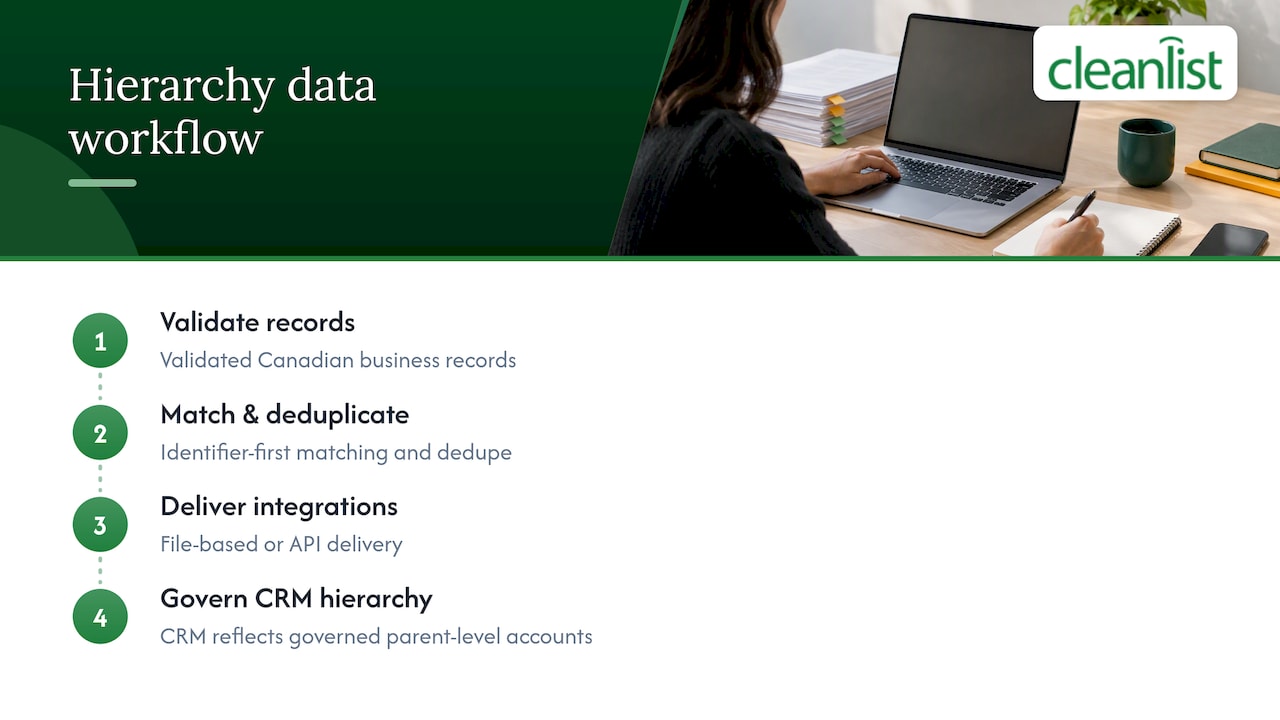
Mapping corporate hierarchy only pays off when the underlying contact and business data behind each entity is current. We built ResponseCanada™ Business to give enterprise marketing and sales teams validated records across millions of Canadian businesses, so a parent-level account profile is populated with contacts and firmographics that match the entity you just confirmed, not a stale name-matched guess.
Our Database Cleaning and Enrichment Services apply the same identifier-first discipline described above: records are matched, deduplicated, and delivered through file-based or API integration so your CRM reflects the governed hierarchy rather than fighting it. Data processing and storage within Canada can be important for hierarchy programs subject to regulated sectors with domestic compliance requirements.
If your account mapping is being held back by inconsistent business records, request a free assessment and we will walk through where your current data creates duplicate or misrouted accounts.
FAQ
What is hierarchy data?
Hierarchy data is structured information describing how entities relate to each other within a defined system, most commonly used in corporate contexts to show ownership from an ultimate parent down through subsidiaries and branches. In business use, it is distinct from an org chart, which shows reporting lines rather than legal ownership.
What is the order of hierarchy in a company?
A typical corporate ownership hierarchy runs from the ultimate parent at the top, through any intermediate holding companies, down to direct parents and finally subsidiaries, branches, or divisions. Reporting hierarchy, by contrast, usually runs from a board or chief executive down through senior leadership to operational teams, and the two structures do not always align.
What are the levels of data hierarchy?
In a general data-management sense, hierarchy typically moves from the smallest unit, a character, up through fields, records, files, and databases. Applied to company data specifically, the equivalent levels run from a single attribute on an entity, to the entity record itself, to the subsidiary, and up to the ultimate parent.
What is an example of a hierarchical database?
A hierarchical database organizes records in a tree structure where each child record has exactly one parent, similar to a file directory system. Corporate ownership registries, such as the Statistics Canada Inter-corporate Ownership product, apply a comparable logic to represent which parent entity controls each subsidiary.
Sources
Primary registries and identifier standards referenced in this guide.