


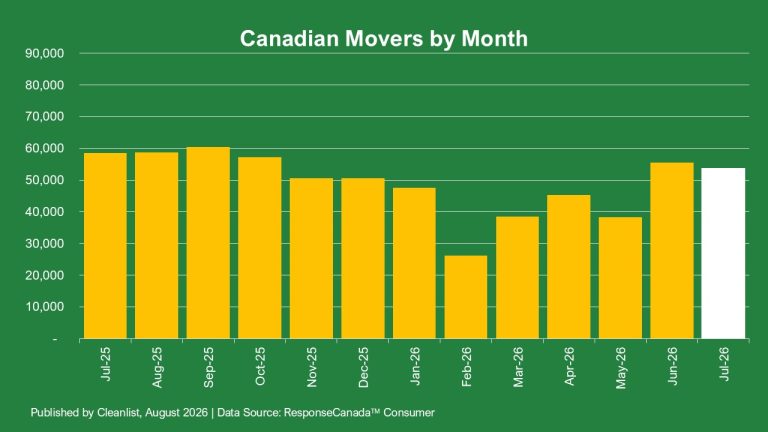
Canada recorded 53,862 mover households in July 2026, compared to 55,579 in June.
This represents a 3.1% month-over-month decrease, reflecting a modest normalization in completed relocations after June reached the highest mover activity recorded so far in 2026.
July continued to represent a significant opportunity for organizations using a Canadian consumer database to identify and engage new mover households during an active stage of the customer lifecycle.
Mover Activity Remains Elevated Through the Summer
Mover activity typically follows housing transactions and relocation planning with a lag, as home purchases, rental agreements, and moving preparations ultimately translate into completed moves.
Recent mover activity illustrates this seasonal trend:
- July 2026: 53,862
- June 2026: 55,579
- May 2026: 38,375
- April 2026: 45,270
- March 2026: 38,419
- February 2026: 26,204
- January 2026: 47,473
Although July recorded a slight decline from June’s peak, mover activity remained well above levels seen earlier in the year, reflecting the continued strength of Canada’s summer moving season.
Ontario Continues to Lead National Mover Activity
Canada’s largest provinces continued to account for the majority of mover households recorded in July:
- Ontario: 25,237 (+0.5% MoM)
- Quebec: 8,968 (-17.3% MoM)
- Alberta: 8,113 (+17.1% MoM)
- British Columbia: 7,128 (-13.4% MoM)
Ontario accounted for approximately 47% of all mover households recorded nationally in July, maintaining its position as Canada’s largest mover market.
Among the four largest provinces, Alberta recorded the strongest month-over-month growth, while Quebec and British Columbia experienced seasonal pullbacks following stronger June activity.
Provincial Trends Were Mixed in July
Following the broad-based increase recorded in June, provincial mover activity became more varied in July.
Notable month-over-month increases included:
- Prince Edward Island: +27%
- Saskatchewan: +15%
- Alberta: +17%
- Manitoba: +8%
Meanwhile, several provinces recorded declines:
- Quebec: -17%
- British Columbia: -13%
- Nova Scotia: -16%
- New Brunswick: -12%
- Newfoundland and Labrador: -10%
While overall mover activity eased slightly from June’s seasonal high, July remained one of the strongest months of 2026 for completed household relocations.
What This Means for Marketers
Recent movers remain one of the highest-intent consumer audiences available.
These households have recently completed their move and are actively making purchasing decisions related to:
- Furniture and home furnishings
- Internet, utilities, and telecommunications
- Insurance and financial services
- Home improvement and renovation projects
- Local retail and service providers
Unlike pre-movers, who are still planning and researching, movers are actively establishing their new households and making immediate purchasing decisions.
For organizations leveraging a Canadian Consumer Database New Mover Household Mailing List, July continues to provide valuable opportunities to engage consumers while new purchasing habits, brand preferences, and service relationships are still being established.
Bottom Line
Although mover activity declined modestly from June’s record high, more than 53,000 Canadian households completed a move in July, making it another exceptionally active month for residential mobility.
As the summer moving season continues, organizations can still capitalize on a large population of newly relocated consumers who are actively establishing new purchasing relationships and service providers.
📊Leverage Cleanlist’s New Mover Data
Cleanlist’s New Mover dataset is Canada’s most comprehensive, continuously updated source of verified move activity. With Cleanlist, you can:
Target movers by geography, household profile, or precise move timing
Align outreach with critical post-move decision windows
Improve campaign accuracy and ROI using high-quality, AI-ready data
📩 Want mover data for your area?
Cleanlist offers a free personalized data discovery report to help you see exactly how many movers are available in your target market — and how you can put that insight to work.