


After September’s strong rebound, Canada’s new business activity took another significant turn in October.
A total of 4,784 new businesses were identified during the month, down from 11,101 in September. That represents a 56.9% month-over-month decrease, bringing activity to its lowest level since January 2026.
Meanwhile, reported business closures remained relatively stable.
Canada recorded 24,416 reported closures in October, compared with 25,124 in September — a decrease of approximately 2.8%.
The contrast is notable.
While newly identified business opportunities declined considerably, the volume of reported closures changed very little.
For organizations using a Canada business database, October reinforces the importance of tracking both new business activity and business closures to maintain accurate prospecting and customer records.
October Reverses September’s New Business Rebound
September had delivered a strong increase in newly identified businesses following August’s slowdown.
October reversed that momentum.
Looking at the past 13 months provides a clearer picture of how new business activity has fluctuated.
Canada’s New Business Activity
13-Month Rolling Trend
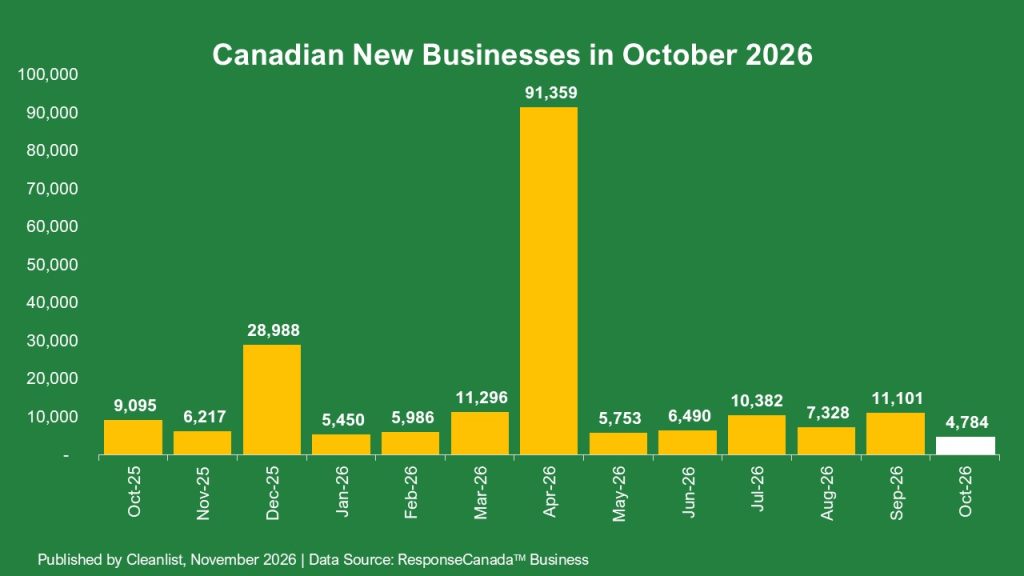
The trend shows considerable variation in newly identified businesses over the past year.
After recording 7,469 new businesses in October 2025, activity declined through November before rising sharply in December.
The first quarter of 2026 brought mixed results, with new business counts ranging from 4,387 in January to 8,737 in March.
April then recorded an exceptional 71,999 new businesses, a volume substantially higher than any other month in the period.
This unusually large figure stands apart from typical monthly activity and should be considered separately when evaluating the broader trend.
Following April, activity returned to lower levels before strengthening through July and September.
September’s 11,101 new businesses represented the strongest monthly volume since April.
However, October’s decline brought the total back to 4,784, nearly matching May’s count of 4,783.
The year-over-year comparison also shows a substantial decrease.
October 2025 recorded 7,469 new businesses, putting October 2026 approximately 36% lower than the same month last year.
The 13-month trend illustrates how quickly newly identified business volumes can change, reinforcing the importance of using current data rather than relying on historical prospect counts.
Reported Business Closures Remain Relatively Stable
While new business activity declined sharply, reported closures showed considerably less movement.
Recent monthly closure counts provide the context:
- October 2026: 24,416
- September 2026: 25,124
- August 2026: 41,326
- July 2026: 36,632
- June 2026: 36,700
- May 2026: 16,487
- April 2026: 38,215
- March 2026: 40,388
- February 2026: 73,421
- January 2026: 8,754
October’s closure volume was approximately 2.8% lower than September, following the much larger 39.2% decline recorded in the previous month.
Compared with October 2025, when 29,694 closures were reported, the latest total was approximately 17.8% lower year over year.
This marks a second consecutive monthly decline in reported closures, with October’s volume remaining well below the elevated levels recorded during several earlier months of 2026.
However, closure counts can be influenced by reporting schedules, administrative updates, and processing cycles.
A lower number of reported closures should therefore not automatically be interpreted as evidence of improving business survival rates or broader economic conditions.
For organizations maintaining customer and prospect databases, the practical implication remains clear: another 24,416 closure records were reported in October, reinforcing the need for ongoing database maintenance.
The Gap Between New Businesses and Closures Widens
October’s contrasting movements created a wider difference between newly identified businesses and reported closures.
- New businesses: 4,784
- Reported closures: 24,416
- Difference: -19,632
In September, the comparable difference was -14,023.
The gap therefore widened by 5,609 records in October.
This change was driven primarily by the sharp decline in newly identified businesses rather than an increase in reported closures.
Importantly, these figures should not be interpreted as a direct measure of Canada’s net business creation or loss.
New business and closure records may follow different reporting and processing cycles, so the difference between the two should not be treated as a direct calculation of Canada’s net business population.
Instead, the comparison illustrates how differently these two components of the business data environment can behave.
For sales, marketing, and data management teams, both measures have practical implications.
Fewer New Businesses Make Targeting More Important
October’s lower new business volume means fewer newly identified prospects were available than in September.
That does not eliminate acquisition opportunities.
Newly established businesses often make important purchasing decisions as they begin operations, including:
- Selecting suppliers and service providers
- Establishing telecommunications and technology services
- Choosing banking, insurance, and professional services
- Purchasing equipment and operational supplies
- Developing marketing and customer acquisition strategies
- Building relationships with long-term business partners
These early decisions can create opportunities for organizations that reach businesses at the right stage of development.
In October, 4,784 new businesses were identified, providing a targeted audience for organizations seeking to connect with emerging companies.
For organizations using a Canada Business Database New Business Start-up List and Closures, timely identification and accurate contact information can help make prospecting more efficient, particularly when the available audience is smaller.
Reaching new businesses early can also help organizations establish relationships before purchasing habits and vendor preferences become firmly established.
Business Database Maintenance Remains Essential
October’s results highlight why business database management requires ongoing attention.
New business activity can fluctuate significantly from one month to the next, while closure records continue to accumulate.
Over the past three months alone, the dataset identified:
- 24,499 new businesses
- 90,866 reported business closures
These figures represent substantial changes that organizations may need to account for in their CRM systems, marketing databases, and prospect lists.
Without regular updates, databases can retain outdated business records while missing newly established organizations.
For sales and marketing teams, this can lead to wasted outreach, inaccurate prospect counts, and missed acquisition opportunities.
Keeping business data current can help organizations:
- Identify new businesses as they enter the market
- Flag closed businesses for review or suppression
- Improve the accuracy of sales and marketing lists
- Reduce wasted outreach and mailing costs
- Maintain more reliable market and customer intelligence
The objective is not simply to maintain a large database.
It is to maintain one that reflects the businesses organizations can meaningfully reach.
Bottom Line
October brought another significant change to Canada’s new business landscape.
New business activity fell 56.9% month over month to 4,784, the lowest monthly total since January.
Reported business closures, meanwhile, declined only 2.8% to 24,416, following September’s much larger decrease.
Year over year, both measures were lower: new business activity declined approximately 36%, while reported closures decreased nearly 18%.
The 13-month trend also highlights considerable fluctuations in new business activity, including April’s exceptional reporting volume and the sharp changes recorded during the second half of the year.
For sales and marketing teams, October brought a smaller pool of newly identified prospects, making accurate targeting and timely contact information particularly valuable.
For data teams, more than 24,000 additional reported closures underscore the continuing importance of keeping business databases current.
The takeaway is clear: Canada’s business landscape continues to change, and maintaining an accurate database requires keeping pace with both new business activity and reported closures.
🔍Want to Reach Canada’s Newest Businesses?
Cleanlist offers free self-service counts to help you size the opportunity. See our business data page for more information and links.