

Between Black Friday and Boxing Day, Canadian retail transaction velocity surges between 300% and 500%. Warehouses operate around the clock, seasonal customer support agents are onboarded en masse, and automated fraud-scoring thresholds are routinely loosened to avoid triggering false-positive declines on legitimate high-ticket holiday shoppers.
Organized retail crime (ORC) syndicates and credential-stuffing rings are acutely aware of this operational pressure. Rather than attacking active accounts where an immediate card-not-present alert prompts the owner to freeze the transaction, bad actors increasingly exploit a blind spot in enterprise CRM and loyalty databases: ghost accounts.
A ghost account is an authenticated, established customer profile that has fallen dormant—most critically, profiles belonging to deceased individuals. When un-scrubbed databases sit open through the fourth quarter, fraudsters weaponize these identities to drain loyalty rewards, bypass anti-fraud velocity filters, and secure instant retail credit.
For enterprise risk officers, fraud directors, and retail operations leads, protecting holiday margins requires closing the mortality data gap before peak volume hits.
The Anatomy of an Exploit: Why Deceased Profiles Are Prime Targets
Dormant accounts are inherently low-risk targets for attackers because the rightful account holders are not checking balances, opening weekly marketing emails, or receiving push notifications. When the account holder is deceased, that silence is permanent.
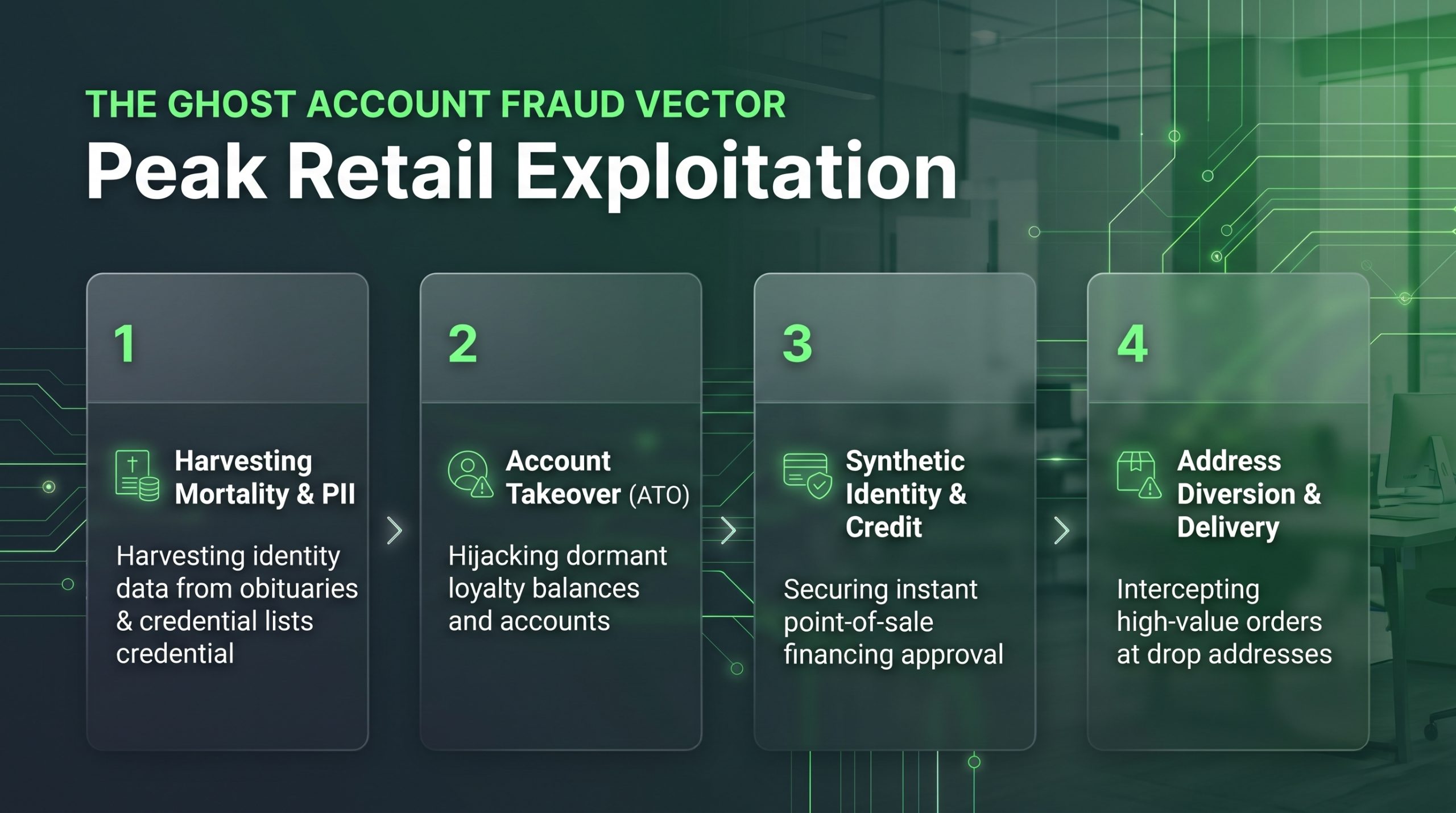
Fraud rings execute this exploit across three primary vectors during the holiday corridor:
1. Loyalty Points Draining and Digital Gift Card Conversion
Loyalty points represent unhedged balance sheet liabilities for retailers. In accounts inactive for 12 months or longer, points balances often sit forgotten. Fraudsters match credential dumps against retail loyalty portals, take over the profile, and convert accumulated points into digital gift cards, electronics, or gaming consoles. Because there is no active cardholder monitoring the account, the breach often goes undetected until an executor reviews estate assets months later.
2. Synthetic Identity Creation and Instant Retail Credit
Peak holiday checkout environments prioritize low friction. Buy-Now-Pay-Later (BNPL) platforms, co-branded retail credit cards, and instant in-store financing options use automated underwriting designed to approve shoppers in seconds. By pairing a real deceased individual’s name, historical address, and identity coordinates with a new, temporary physical drop address and digital burner contact, fraudsters construct high-trust synthetic profiles that slide cleanly past standard credit checks.
3. Account Takeover (ATO) Address Diversions
Legacy accounts with long transaction histories possess built-in trust scores within merchant risk engines. Fraudsters take over an inactive deceased customer’s profile, change the delivery address to a vacant property, short-term rental, or parcel locker, and place high-value orders using stolen credit cards. Because the account itself has years of positive purchase history, fraud-scoring algorithms frequently greenlight the transaction without manual review.
The Triad of Damage: Financial, Operational, and Reputational
When deceased profile exploitation occurs, the damage extends beyond stolen merchandise:
- Direct Bottom-Line Losses: Retailers absorb chargebacks from fraudulent payment methods, write off uncollectible debt from defaulted instant credit accounts, and lose high-margin inventory that cannot be recovered.
- Escalated Legal and Probate Friction: When retailers attempt to collect on unpaid debts or send notices for compromised accounts, the communications land in the hands of grieving families, estate executors, and probate attorneys.
- Brand Reputation Destruction: Nothing damages consumer trust faster than dispatching collection letters, debt notices, or promotional holiday mailers addressed to someone who passed away months earlier. A single grieving family member posting a callous automated debt notice on social media can unravel millions of dollars in holiday brand equity.
Why Traditional Canadian Data Sources Fail to Prevent It
Many enterprise fraud-prevention teams assume their standard verification stacks or credit bureau integrations automatically flag deceased individuals. In Canada, this assumption creates an immense security vulnerability.
Unlike the United States, which maintains a unified federal Death Master File (DMF) via the Social Security Administration, Canada has no centralized federal death register.
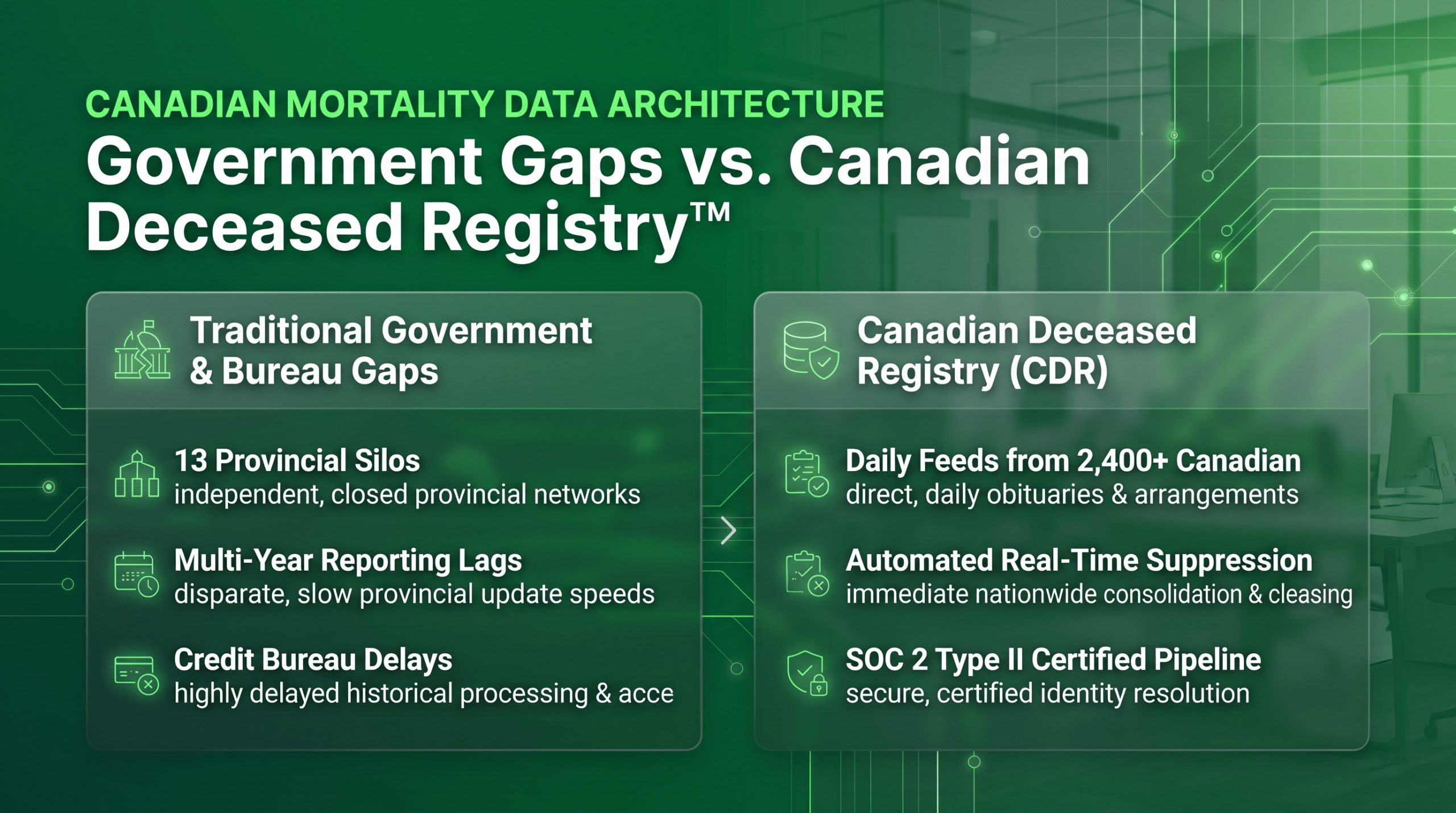
Provincial Jurisdictional Silos: Vital statistics are managed independently by 10 provinces and 3 territories. Each operates under strict statutory privacy restrictions that prohibit real-time commercial API queries.- Multi-Year Reporting Lags: Aggregated federal mortality datasets published by agencies like Statistics Canada are historical and anonymized—designed for demographic research rather than operational identity verification or fraud prevention.
- The Credit Bureau Window: While credit bureaus eventually flag deceased files, there is routinely an operational gap of several months between a person’s death, estate notification, and bureau updates. That multi-month window covers the entire Q4 promotional corridor.
The Proactive Defense: Pre-Holiday Registry Suppression
Closing the ghost account vulnerability requires proactive database screening before campaign launches and holiday checkout surges freeze your systems.
1. Pre-Flight Batch Cleansing for Dormant Accounts
Before launching holiday promotional sends, loyalty point balance reminders, or reactivations, isolate all accounts that have shown zero transactional or login activity over the preceding 6 to 12 months. Screen this dormant cohort against the Canadian Deceased Registry™ (CDR) to identify and suppress deceased profiles before they are targeted by credential-stuffing sweeps.
2. Dynamic Address Anomaly Flagging
When an established account that has been dormant for over 180 days suddenly updates its physical shipping address and immediately orders high-risk merchandise, flag the profile. Cross-referencing address updates with Canada Post NCOA™ mover registries determines whether the customer genuinely relocated or whether the account was hijacked to an unauthorized drop point.
3. Step-Up Authentication on Sensitive Actions
Require multi-factor authentication (MFA) or secondary verification whenever a customer requests a high-value loyalty points redemption, email change, or physical address change on an account with a history of dormancy.
How Cleanlist Secures Enterprise Databases
Cleanlist operates Canada’s largest and most comprehensive database of deceased consumer intelligence through the Canadian Deceased Registry™ (CDR). Built specifically to overcome Canada’s unique jurisdictional challenges, the CDR is compiled daily from direct relationships with more than 2,400 Canadian funeral homes, daily obituary monitoring, and direct consumer filings.
Integrating Cleanlist into your fraud and risk management workflows provides:
- The Largest Independent Canadian Mortality Database: Access millions of verified Canadian deceased records that are unavailable through traditional US-centric data vendors or slow public channels.
- Daily Intelligence Updates: Close the dangerous gap between a customer’s passing and credit bureau notification, stopping ghost account takeovers before they occur.
- Proprietary Canadian Address Matching: Cleanlist’s advanced matching algorithms account for complex Canadian address formats, bilingual street naming conventions, and rural route designations to eliminate false positives and catch sophisticated synthetic variants.
- Enterprise Security Standards: All data processing is executed within Canada under rigorous SOC 2 Type II certified controls, ensuring total regulatory alignment with Canadian privacy standards, including PIPEDA and Quebec Law 25.
Before fraud rings take advantage of holiday velocity, audit your customer databases. Contact Cleanlist today to run a Deceased Suppression Audit and lock down dormant accounts ahead of peak season.