


During the fourth quarter, Canadian enterprise retailers scale fulfillment networks to maximum throughput. Warehouses add extra shifts, freight lines lock in dedicated line-hauls, and e-commerce platforms handle record transaction volumes.
Yet, when order tracking status flips to “Address Incomplete” or “Delivery Exception,” the breakdown rarely stems from simple single-family residential homes. Instead, delivery failures systematically cluster around Canada’s non-standard physical delivery modes: high-rise apartment units, rural route mailboxes, and postal box installations.
More than 35% of Canadian households do not receive mail via a dedicated door-to-door mail slot or private single-family front porch. Instead, they rely on multi-tenant building mailrooms, centralized Community Mail Boxes (CMBs), rural route delivery contractor boxes, or Retail Postal Outlets (RPOs).
When e-commerce checkouts and backend Warehouse Management Systems (WMS) treat Canadian geography through generic, US-centric addressing assumptions, these non-standard delivery modes fail. The result is a compounding operational bottleneck: carrier address correction penalties, rerouted parcels, delayed delivery dates, and spiked support volumes during the most critical shopping weeks of the year.
The Canadian Delivery Mode Reference Taxonomy
Under Canada Post’s Software Evaluation and Recognition Program (SERP), every physical delivery point in Canada is classified into specific operational delivery modes. Logistics systems must parse and validate these distinct schemas rather than forcing them into a flat “Street Address” line:
| Delivery Mode Code | Delivery Mode Name | Official Infrastructure / Mechanics | Primary Operational Failure Point |
| NC | Normal Civic | Single-family detached street delivery | Minor typographical errors or missing directional qualifiers (e.g., East vs. West) |
| APT / UNIT | Multi-Tenant Civic | Multi-unit residential or commercial buildings (apartments, condominiums, office suites) | Secondary unit numbers omitted, placed on incorrect lines, or stripped by label printers |
| RR | Rural Route | Roadside mailboxes serviced by motorized rural route contractors | Structural conflict between municipal 911 physical road names and official postal RR routing numbers |
| PO BOX / CP | Post Office Box (Case Postale) | Secured lockboxes inside Canada Post postal stations or Retail Postal Outlets (RPOs) | Private commercial couriers attempting final-mile delivery to secure postal property without handoff rights |
| GD / PR | General Delivery (Poste Restante) | Mail held at a local corporate postal counter for manual collection | Missing station identifiers or recipient name discrepancies during collection |
| SS / MR | Suburban Service / Mobile Route | Grouped delivery points serving fringe developments | Missing group/site/compartment numbers |
The 3 Address Exceptions That Disrupt Q4 Fulfillment
1. The Multi-Tenant Unit Stripping Defect (Condos & Apartments)
Urban Canadian demographics have shifted rapidly toward high-density multi-tenant dwellings. In metropolitan markets like Toronto, Vancouver, and Montreal, high-rise condominiums represent the dominant residential delivery profile.
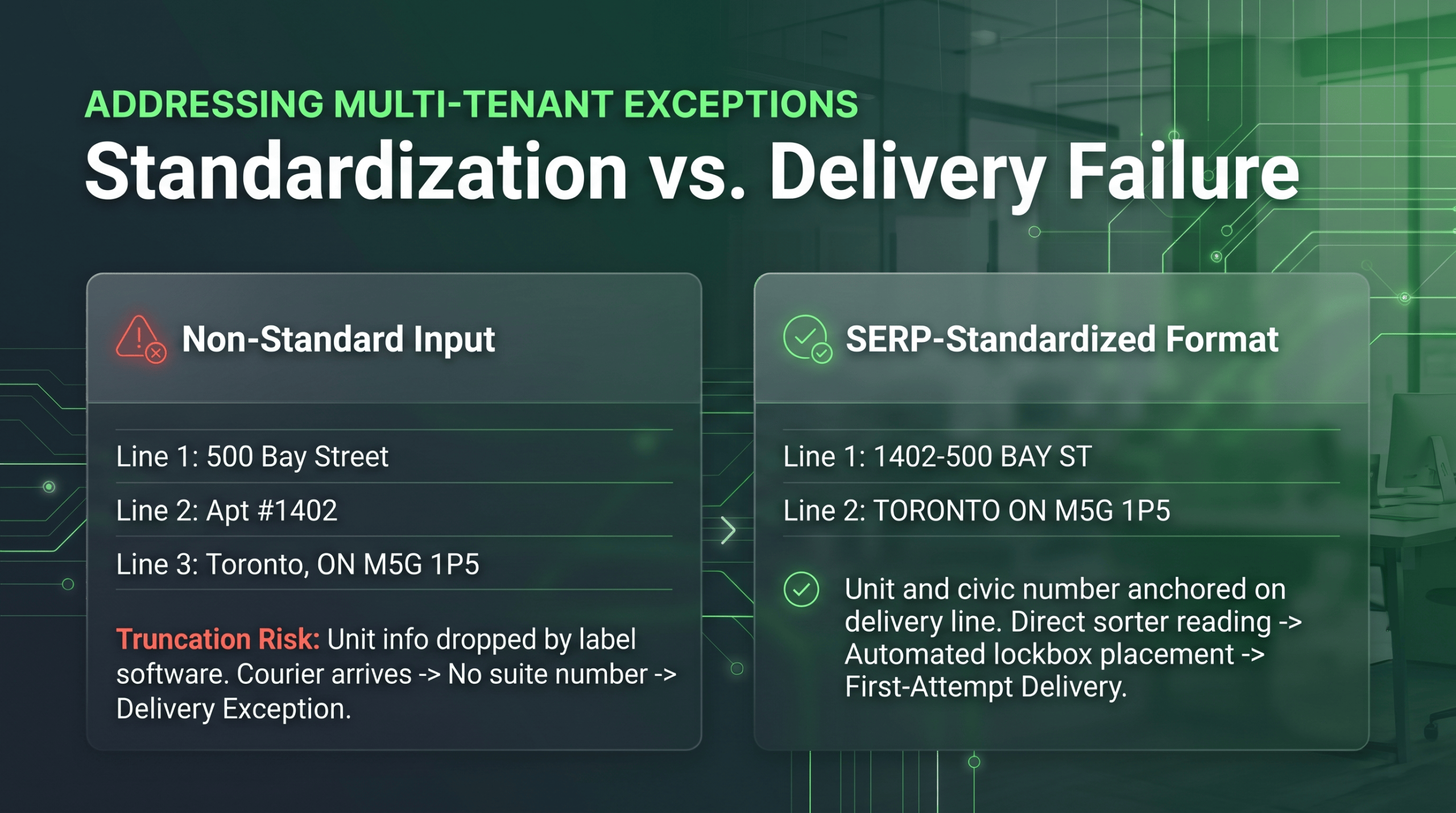
- The Input Failure: Canadian consumers frequently enter unit information using non-standard formatting, such as Apt 1402 – 500 Bay St, 500 Bay St, Suite 1402, or 500 Bay St #1402. In forms configured with a secondary “Address Line 2,” shoppers place the unit number on the second line.
- The Downstream Break: Legacy shipping integrations, thermal label printers, and Electronic Data Interchange (EDI) feeds routinely truncate or drop “Address Line 2.”
- The Official Canada Post Standard: Canada Post addressing standards mandate placing the unit number before the civic number, separated by a hyphen, without punctuation or symbols like # or No. (e.g., 1402-500 BAY ST).
- The Logistical Impact: Packages arrive at high-density residential mailrooms with the building number intact but no unit identifier. Couriers cannot identify the recipient’s locker or door, triggering an immediate “Address Incomplete” exception. The carrier applies an Address Correction Surcharge ($5.00 to upwards of $18.00 CAD per package) and holds the parcel at a regional depot, missing holiday delivery promises.
2. The Rural Route (RR) vs. Municipal 911 Civic Disconnect
Rural parcel delivery in Canada presents an operational dual-identity challenge that US-based platforms are not built to process.
- The Structural Split: Across rural Ontario, Quebec, the Prairies, and Atlantic Canada, municipalities assigned physical civic road numbers (e.g., 4522 COUNTY RD 10) to support emergency 911 dispatch. However, Canada Post delivery routing for mail delivery points frequently retains the historical rural route system (e.g., RR 3 STN MAIN).
- The Carrier Conflict:
- Canada Post: Sorting machinery operates on rural route identifiers and postal codes to direct mail to contractor routes.
- Commercial Line-Haul Couriers (FedEx, UPS, Purolator): Depend on geographic street coordinate databases to plot delivery routes and will reject rural route (RR) designations as invalid addresses.
- The Result: If an e-commerce customer enters their 911 emergency address without the corresponding postal delivery mode, national postal sorters flag the record for manual sorting. If they enter only RR 3, commercial couriers reject the package before dispatch, forcing warehouse staff into manual exception handling.
3. The “Rural Zero” Forward Sortation Area (FSA) Bottleneck
In the Canadian alphanumeric postal code schema (A1A 1A1), the second character provides critical logistical telemetry:
- A numeral other than zero (e.g., M5V, V6B, H3B): Designates an urban delivery area.
- The numeral zero (e.g., K0A, T0E, B0J): Designates a rural delivery area.
- The Delivery Reality: Rural FSAs rarely have door-to-door parcel delivery. Deliveries are routed to centralized Community Mail Boxes (CMBs) equipped with secure parcel compartments, or directly to a local Retail Postal Outlet (RPO) inside a local pharmacy or general store.
- The Peak Season Bottleneck: During peak holiday parcel spikes, CMB parcel compartments fill immediately. When lockers are saturated, carriers leave a delivery notice card instructing the customer to collect the parcel at the designated RPO depot.
- The Friction: When retailers promise direct-to-door delivery on orders dispatched to rural zero FSAs, mismatched expectations generate an influx of “Where Is My Order?” (WISMO) support inquiries.
Logistical Impact Matrix: Input Errors vs. Financial Repercussions
| Exception Type | Trigger Mechanism | Carrier Response | Financial & Operational Impact |
| Missing Suite / Unit | Multi-unit details omitted or truncated from Address Line 2 | Parcel flagged as “Address Incomplete”; returned to hub | 13.50–18.00 CAD correction fee; 48–72 hr transit delay |
| Commercial Courier to PO Box | Dispatching FedEx/UPS to a Canada Post PO Box lockbox | Immediate refusal at sorting facility; Return-to-Sender (RTS) | Full round-trip shipping cost lost; inventory trapped in transit |
| Unformatted Rural Route | Missing station or route identifier on rural delivery | Ejected from automated high-speed optical sorters | $0.05 CAD SERP penalty per piece; manual keying delay |
| Invalid Rural Postal Code | Transposed characters or mismatched FSA / municipal name | Parcel misdirected to incorrect regional sorting plant | Cross-dock transfer surcharges; missed holiday delivery cutoffs |
Architectural Remediation: Solving Edge Cases at Scale
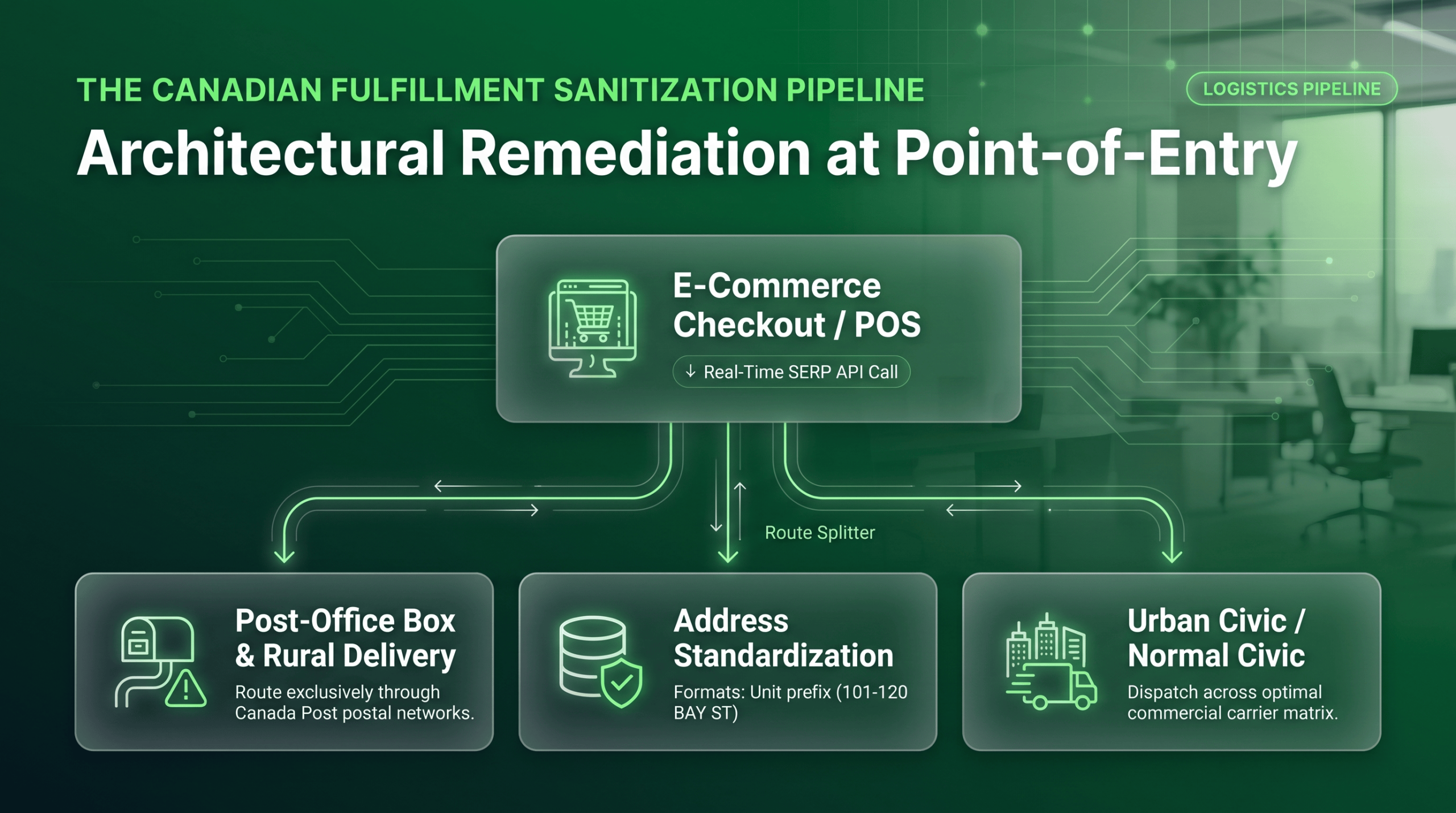
Eliminating delivery exceptions requires systemic data hygiene at two critical touchpoints: point-of-capture and pre-fulfillment dispatch.
1. Point-of-Entry Address Standardization
Rather than relying on basic browser autofill or generic global geocoders, checkout forms should integrate an address verification engine evaluated and recognized under Canada Post’s Software Evaluation and Recognition Program (SERP).
- Automatically parses unit numbers into the correct prefix format (Unit-Civic).
- Validates street types, directional qualifiers, and postal codes in real time.
- Standardizes bilingual street names across English and French conventions (e.g., Chemin vs. Rd, Rue vs. St).
2. Pre-Fulfillment Split Routing Logic
Prior to label printing, order processing engines should analyze the standardized delivery mode:
- Rule A: If the destination record contains a PO BOX, General Delivery (GD), or non-civic rural designation, automatically route the order to postal services capable of servicing lockboxes.
- Rule B: If the destination is an urban civic address (NC or APT), route across the optimal commercial carrier matrix based on cost and transit performance.
How Cleanlist Solves Canadian Logistics Complexity
Cleanlist is Canada’s premier address accuracy and data solutions provider, operating specialized data infrastructure designed specifically for Canadian geographic and postal realities.
Before peak holiday fulfillment strains your logistics network, Cleanlist helps enterprise retailers eliminate delivery exceptions and protect operating margins:
- Canada Post SERP-Certified Address Validation: Cleanlist’s address validation and correction engines are officially recognized under Canada Post’s SERP guidelines, ensuring your customer records meet the highest deliverability standards.
- Real-Time Address Autocomplete & Verification APIs: Cleanlist’s point-of-entry APIs instantly correct typographical errors, standardize unit/civic numbers, and validate postal codes directly within your e-commerce checkout before orders are submitted.
- Comprehensive Canadian Delivery Point Validation (DPV): Identify whether an address corresponds to a single-family home, a high-rise apartment suite, a rural route box, or a post office box before committing packages to carrier line-hauls.
- High-Volume Pre-Fulfillment Batch Audits: Cleanse and verify entire holiday order queues in automated batches, correcting postal anomalies and preventing costly carrier correction surcharges.
Do not allow non-standard Canadian delivery modes to derail your holiday fulfillment. Contact Cleanlist today to audit your shipping data and deploy SERP-certified verification ahead of peak season.