


To achieve mover marketing compliance in Canada, you must satisfy CASL, PIPEDA, the Competition Act and National Do Not Call List obligations at once, and advertisers stay accountable even when a vendor supplies the list. The single control that prevents most liability is a channel-by-channel consent record tied to supplier provenance. Some mover data products are built around that discipline, which makes them a practical starting point for teams that need compliant lists fast.
TL;DR:
- Marketers must maintain channel-specific consent records and proof of vendor provenance to comply with CASL and PIPEDA requirements.
- Using a purchased list requires documented evidence of how consent was obtained; outsourcing does not transfer accountability to the vendor.
- Provinces set their own advertising rules, so claims must be tailored to each destination jurisdiction before launching campaigns.
- Unsubscribe requests must be honored within 10 business days, and sender contact details must remain valid for at least 60 days after sending.
- Canadian-sourced, compliance-focused data products, like those from Cleanlist, facilitate accurate suppression and provenance tracking for mover marketing.
Table of Contents
- Canada’s legal framework for mover marketing
- Operational controls that make mover campaigns defensible
- Third-party lists, vendors and contracting
- Pre-launch checklist for mover marketing campaigns
- Publisher perspective: what a Canada-first data partner changes
- How Cleanlist can help with compliant mover data
- Primary sources and regulator guidance to consult
- Sources
- FAQ
Canada’s legal framework for mover marketing
Four separate regimes touch a single mover campaign, and each has its own evidentiary demands. CASL governs commercial electronic messages: you need express or implied consent, clear sender identification and a working unsubscribe mechanism, and the burden of proving consent sits with the sender, not the recipient, according to CRTC guidance. Implied consent is narrower than most marketers assume and it expires, so a lead captured eighteen months ago for a different purpose usually cannot support today’s mover promotion.
PIPEDA and the matching provincial statutes require meaningful consent for collecting, using and disclosing personal information, and the Office of the Privacy Commissioner is explicit that outsourcing list acquisition never removes the advertiser’s accountability. If a vendor’s data was collected without disclosing that a moving company would use it, the buyer inherits that gap.
The Competition Act prohibits materially false or misleading representations, and the Competition Bureau judges ads on their general impression, not on a technically accurate footnote. A headline promising a guaranteed delivery date cannot be rescued by fine print that contradicts it.
Outbound calling adds the National Do Not Call List: telemarketers must register and subscribe for the area codes they call and be ready to show express consent for non-exempt calls, per the DNCL program.
Finally, mover operating and advertising rules are not federal. Each destination province or territory sets its own conditions, so a claim that is fine in Ontario may need rewording for a campaign reaching Alberta or Quebec.
- CASL: consent, identification, unsubscribe, and the sender carries the proof burden.
- PIPEDA: meaningful consent and accountability that survives outsourcing.
- Competition Act: general-impression test, not literal accuracy alone.
- DNCL: registration, subscription and documented consent for calls.
- Provincial mover rules: verified per destination jurisdiction.
Operational controls that make mover campaigns defensible
Legal obligations only matter if the campaign workflow can prove they were met. Build these controls into the process before creative goes live, not after a complaint arrives.
- Store consent and suppression as separate fields per channel, and record the sender name and permitted scope alongside each consent, since a mailing address permission does not authorize a text message.
- Design every consent capture point to state the purpose, the likely recipients and any cross-border disclosure, because a vague “we may contact you” line will not satisfy PIPEDA’s meaningful consent standard.
- Maintain a searchable evidence store that links consent logs, unsubscribe events, DNCL check results and delivery confirmations to each contact record.
- Substantiate every claim in creative, insurance coverage, licensing status or guaranteed dates, with a document you can produce on request, and put material limits in the visible copy rather than a disclaimer block.
- Process unsubscribe requests within CASL’s 10 business day window and keep sender contact information valid for at least 60 days after any send.
Pro Tip: Tag every consent record with the exact campaign, channel and date it was captured, so a single audit query can reconstruct the full chain from opt-in to send.
Teams that treat consent capture as a design problem rather than a legal afterthought tend to build cleaner forms in the first place. A partner resource on building an opt-in list covers practical capture mechanics that complement the legal requirements above.
Third-party lists, vendors and contracting
Buying a list does not transfer legal responsibility. OPC guidance confirms that advertisers remain accountable for how their suppliers collected and maintain data, so procurement needs to function like a compliance review, not a purchase order.
Ask every vendor for consent evidence at the record level, a description of the collection method, confirmation that lists were checked for address harvesting, and the cadence at which suppression updates are pushed to you.
- Require a provenance warranty stating how and when the data was collected.
- Require documentation tying consent to a permitted use and sender.
- Require regular suppression feeds and a breach notification clause.
- Require audit or cooperation rights and, where the relationship warrants it, an indemnity provision.
A vendor that cannot produce a provenance record for a sampled address is a vendor whose entire file deserves a second look.
Pre-launch checklist for mover marketing campaigns
Run this checklist as a gate before any send, call, mailer or ad goes live.
- Email and SMS: confirm proof of consent tied to this specific message type, a clear sender identity and an unsubscribe link tested to work, since CASL requires opt-outs to be honoured within 10 business days.
- Telemarketing: verify DNCL subscription for the area codes you plan to call and have a documented consent script ready for any number you contact under express consent.
- Direct mail: classify the audience as consumer or business, honour any Do Not Mail flags, and confirm the list vendor’s data provenance before printing.
- Paid ads and landing pages: match every headline and image to evidence you can produce, since overpromising visuals create the same general-impression risk as overpromising text.
- Final review: test the unsubscribe flow for accessibility and give creative a legal read focused on general impression, not just literal wording.
A misused operational data source has already drawn regulatory attention: the OPC’s investigation into a national mail program found that marketing use of postal data collected for another purpose can contravene privacy rules without proper authorization, a reminder that even familiar address sources need a documented basis for marketing use.
Publisher perspective: what a Canada-first data partner changes
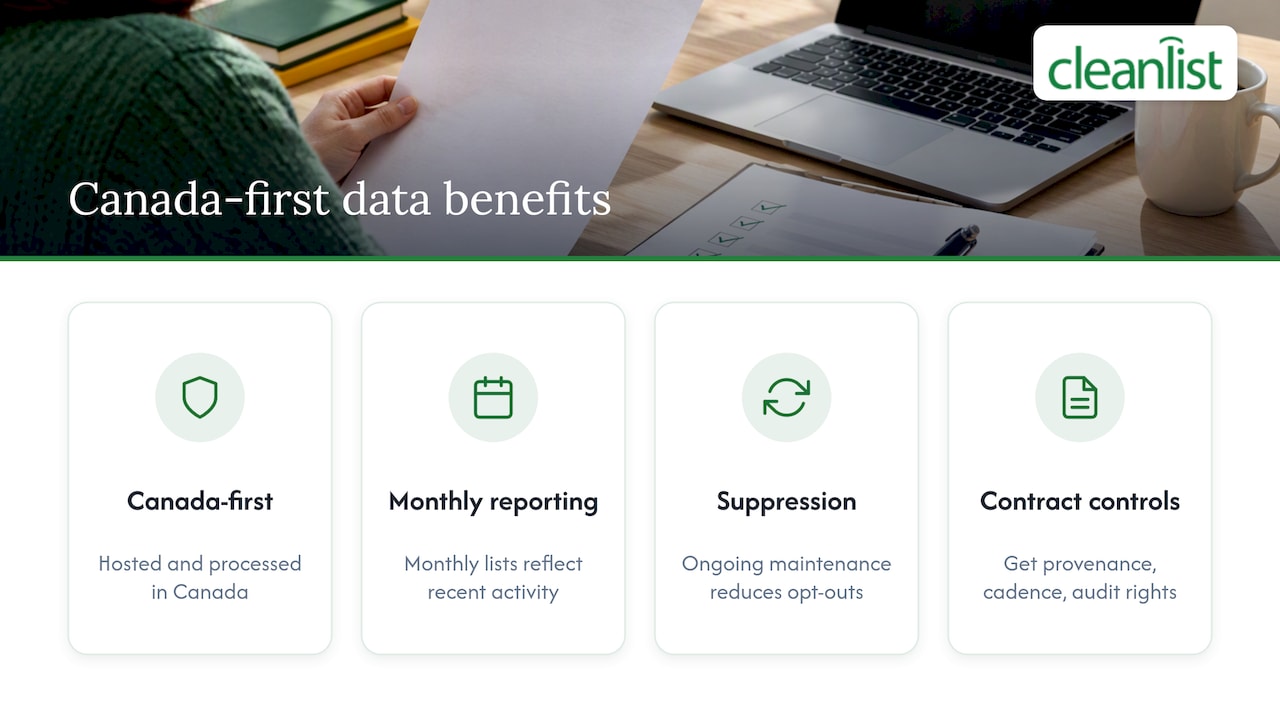
Most failures in mover marketing compliance in Canada trace back to data whose origin nobody can fully explain. Certain data ecosystems cover a very large number of households and businesses, processed and stored entirely within Canada, which keeps cross-border disclosure questions out of the compliance conversation from the start. Monthly pre-mover reporting means lists reflect recent activity rather than static, ageing files, and ongoing suppression maintenance reduces the odds of contacting someone who already opted out.
None of that replaces your own diligence. Whatever vendor you use, request provenance documentation, a suppression update cadence and audit rights in the contract before the first list ships.
— Jeff
How does Cleanlist can help with mover marketing compliance in Canada?
Compliance work is easier when the underlying data was built for it. Cleanlist’s ResponseCanada™ Consumer product line covers movers, pre-movers, seniors and affluent segments with Canadian-sourced records, and Campaign Data Preparation handles suppression updates and postal code targeting so your send list reflects current opt-outs before it reaches production.

Before committing to a list, ask vendors for a sample provenance report and current suppression terms, and confirm what audit access looks like in the contract. You stay accountable for the data you use no matter who supplied it, so build that verification into procurement rather than treating it as optional paperwork. Request a data review to see how a Canada-first list compares against your current source.
Primary sources and regulator guidance to consult
- Competition Bureau: false or misleading representations
- CRTC: CASL frequently asked questions
- OPC: PIPEDA brief
- National Do Not Call List
- Canadian Association of Movers: acts and regulations
Sources
- False or misleading representations and deceptive marketing practices — Competition Bureau
- Frequently Asked Questions about Canada’s Anti-Spam Legislation | CRTC
- PIPEDA brief — Office of the Privacy Commissioner of Canada
- National Do Not Call List (DNCL)
FAQ
What is the main compliance risk when looking for mover marketing compliance in Canada?
The biggest risk is using a purchased list without evidence of how consent was collected, since PIPEDA and CASL both hold the advertiser accountable even when a vendor supplied the data. Keeping a provenance record and channel-specific consent log for every list you buy addresses this directly.
How quickly must an unsubscribe request be honoured under CASL?
Unsubscribe requests for commercial electronic messages must be processed within 10 business days under CASL. Sender contact information also needs to stay valid for at least 60 days after a message is sent.
Do provincial rules affect mover advertising claims?
Yes, mover operating and advertising requirements are set at the provincial and territorial level rather than nationally, according to the Canadian Association of Movers. A campaign reaching multiple provinces needs its claims checked against each destination’s rules before launch.
Is a purchased list enough proof of consent for telemarketing calls?
No, a purchased list alone does not prove consent. Telemarketers must be registered and subscribed to the National Do Not Call List for the relevant area codes and must be able to demonstrate express consent for any non-exempt calls.
Does Cleanlist offer mover-specific marketing data for Canada?
Cleanlist’s ResponseCanada™ Consumer line includes movers and pre-movers segments built from Canadian household data. Buyers should still request provenance and suppression documentation as part of standard procurement diligence.