

The countdown to Black Friday, Cyber Monday (BFCM), and the peak holiday shopping corridor is an operational sprint for Canadian enterprise retailers. Marketing budgets reach their annual apex, warehouses operate 24/7, and freight lines run at maximum capacity.
Yet, every November, enterprise margins leak substantial capital through a quiet, compounding defect: dirty customer records.
Whether executing multi-drop direct mail catalogs, deploying personalized holiday email flows, or bidding on hyper-targeted custom audience segments across Meta and Google, dirty data destroys campaign ROI. Relying on an un-audited database turns your highest-margin season into a costly cycle of carrier penalties, undeliverable parcels, and wasted ad spend.
To safeguard your Q4 investments, run through this five-step pre-flight checklist 14 to 30 days before committing campaign budgets.
The Compounding Ledger: What Un-Audited Data Costs at Peak Volume
Customer data naturally decays. In Canada, demographic mobility is among the highest in the G7: over 2 million Canadian households relocate within a two-year window, driving an annual database decay rate of 15% to 20%. Compounding this, fewer than 20% of consumers update their profiles across corporate accounts when they move.
When you deploy a holiday campaign on an un-audited customer list, the financial drag hits every channel:
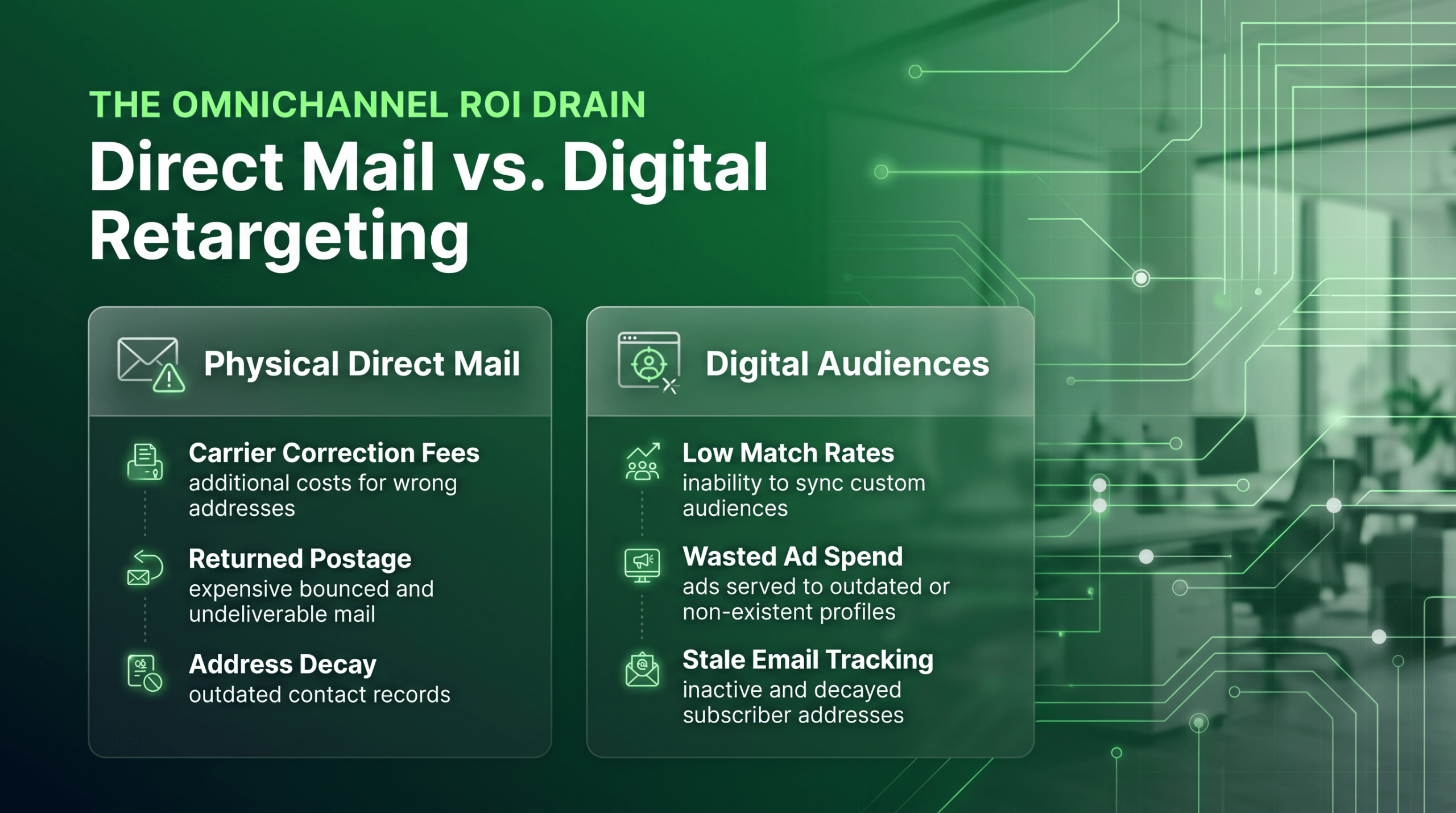
- Direct Mail Waste: Printing, processing, and mailing high-spec catalogs or 6×9 postcards to moved recipients costs ~$0.85 CAD per piece. Across a 100,000-piece drop with 15% move decay, $12,750 CAD goes directly into the recycling bin on unreached recipients.
- Carrier Surcharges & Penalty Fees: Parcels dispatched with inaccurate suite numbers, rural-route anomalies, or invalid postal codes incur carrier address-correction surcharges ($5.00 to upwards of $15.00+ CAD per parcel) or fail into costly Return-to-Sender (RTS) loops.
- Digital Ad Dilution: Outdated email addresses and stale phone numbers yield sub-45% match rates on paid social ad platforms, forcing algorithms to bid blindly on ghost profiles and inflating Customer Acquisition Costs (CAC).
- Customer Support Strain: “Where Is My Order?” (WISMO) tickets surge in December. Gartner research calculates that handling a single live support ticket costs an enterprise an average of $13.50 CAD—consuming critical agent capacity during peak sales weeks.
The 5-Step Pre-Flight Audit Checklist
Step 1: Canada Post SERP Address Standardization
Target: Physical Direct Mail, Fulfillment Logistics, and Warehouse Management Systems (WMS)
A formatted address is not automatically a deliverable address. A customer checkout field may record an address that appears valid to basic web forms, but fails the strict parsing criteria of Canada Post automated sorting equipment.
- The Technical Check: Run all physical postal records through a Canada Post Software Evaluation and Recognition Program (SERP) certified validation engine.
- What It Solves: Validates and corrects street names, directional abbreviations (e.g., King St W vs. King St E), unit/suite formatting, and Forward Sortation Area (FSA) alignment against current national postal records.
- Business Outcome: Ensures your mail files achieve the mandatory 95% accuracy threshold required to avoid Canada Post financial adjustment penalties ($0.05 per defective piece), while eliminating carrier re-labeling surcharges.
Step 2: Canada Post NCOA™ Move-Update Screening
Target: Active Direct Mail Lists, Seasonal Catalogs, and CRM Profiles
The single largest misconception in retail marketing operations is assuming that SERP standardization verifies who lives at an address. SERP confirms the building exists; NCOA™ confirms your customer still lives inside.
- The Technical Check: Cross-reference your customer database against the official Canada Post National Change of Address (NCOA™) registry and proprietary national mover databases.
- What It Solves: Re-links relocated customers to their verified new civic addresses and flags non-forwardable records for suppression.
- Business Outcome: Recovers 15% to 20% of your customer file prior to catalog print runs, preventing wasted postage and ensuring high-LTV buyers actually receive their holiday incentives.
Step 3: Omnichannel Household & Record Deduplication
Target: CRM Contact Databases, Print Mailings, and Direct Sales Outreach
Over months of customer interactions—in-store POS entries, guest e-commerce checkouts, and mobile app downloads—duplicate records proliferate. In retail databases without automated merging, duplicate rates routinely range between 8% and 15%.
- The Technical Check: Apply algorithmic fuzzy matching and household consolidation rules across physical address, email, and phone fields.
- What It Solves: Identifies multiple entries for the same individual (e.g., Chris M. Smith vs. Christopher Smith at the same physical or digital address) and consolidates multiple family members into a single household unit.
- Business Outcome: Eliminates redundant print pieces delivered to the same front door—cutting print and postage overhead immediately—while presenting a polished, unified brand experience.
Step 4: Digital Identifier Append & Verification
Target: Paid Media Custom Audiences (Meta, Google, TikTok), Email & SMS Platforms
Holiday retargeting efficiency depends on high platform match rates. If your custom audience export contains only outdated primary emails, your paid media sync will stall, driving up ad CPMs and limiting audience reach.
- The Technical Check: Verify deliverability on email records (filtering out invalid syntax, spam traps, and dead domains) and append verified Canadian mobile phone numbers and alternate email coordinates to existing CRM files.
- What It Solves: Resolves fragmented customer identities across digital touchpoints.
- Business Outcome: Lifts ad platform match rates from under 45% to over 70%, giving algorithmic bidding engines the rich offline signals required to optimize ad delivery during peak holiday competition.
Step 5: Canadian Deceased Registry™ (CDR) Suppression
Target: All Customer-Facing Communications (Direct Mail, Email, Outbound SMS)
During compressed promotional periods, automated marketing flows run at high volume. Accidentally delivering holiday gift guides, pre-approved credit promotions, or personalized mail pieces addressed to a deceased relative is devastating to brand equity and inflicts deep emotional distress on grieving households.
- The Technical Check: Screen all campaign files against the Canadian Deceased Registry™ (CDR)—the country’s sovereign mortality database continuously compiled from over 2,400 funeral homes and consumer filings.
- What It Solves: Closes the multi-year reporting gap inherent in government vital statistics files, flagging deceased customer records in real time[cite: 5, 8, 9].
- Business Outcome: Protects brand reputation, prevents estate fraud, ensures legal compliance, and saves print and distribution capital on completely unconvertible contacts[cite: 3, 5, 8].
Pre-Flight Implementation Timeline
To deploy this checklist before Q4 promotional drops freeze, use this operational countdown:
| Timeline | Phase | Primary Operational Actions |
| T-30 Days | File Extraction & Audit | Pull master marketing and CRM segments; run an initial deliverability diagnostic to isolate baseline decay and duplicate volume. |
| T-20 Days | Hygiene & Transformation | Execute SERP address standardization, NCOA™ move updates, and household deduplication runs. |
| T-14 Days | Enrichment & Suppression | Screen files against the Canadian Deceased Registry™ and run digital multi-identifier phone/email appends[cite: 1, 3, 8]. |
| T-7 Days | Production & Media Lock | Hand off finalized, clean postal records to commercial print houses and upload verified first-party audience lists to ad networks. |
The Bottom Line
Peak holiday retail success is won in the margins. You cannot out-spend competitor ad budgets if 15% of your digital retargeting bids target dead accounts, nor can you hit catalog sales targets if 15,000 mailers land in the wrong mailboxes.
Taking the time to pre-flight your lists transforms unmanaged database decay into an immediate profit recovery lever—ensuring every dollar committed in Q4 drives measurable revenue.