


When multinational enterprises, financial institutions, and retail brands expand operations into Canada, compliance and risk teams often make an expensive administrative assumption: they assume Canadian mortality data works the same way it does in the United States.
In the United States, screening customer databases for deceased individuals is a straightforward, federalized process. Organizations license the Social Security Administration’s Death Master File (SSDMF) or run files against aggregated credit bureau files powered by centralized federal death disclosures.
In Canada, attempting to locate an equivalent “Federal Death Registry” leads to a swift dead end.
Why? Because there is no federal death master file in Canada. There is no central government clearinghouse that publishes or sells consumer death records to private industry. Organizations that rely on generic global data vendors or US-designed risk workflows often operate under a dangerous illusion of compliance. They leave hundreds of thousands of deceased profiles unflagged in their active CRM databases, directly inviting synthetic identity fraud, estate takeover, and reputation-damaging marketing blunders.
Understanding how deceased data actually functions in Canada requires examining the country’s decentralized statutory framework, the limitations of official public records, and the engineering behind compiled national registries.
The Cross-Border Divide: Centralized Federalism vs. Provincial Privacy
The divergence between American and Canadian mortality intelligence is grounded in constitutional division of powers and privacy jurisprudence.
The United States Model: Centralized Federal Records
In the US, the Social Security Administration (SSA) maintains an ongoing, national record of deaths reported by family members, funeral homes, and financial institutions to halt benefit distributions. Under federal open-government precedents, redacted versions of this data (the Public DMF) have historically been made available to commercial entities through the National Technical Information Service (NTIS) for fraud mitigation and debt collection.
The Canadian Reality: 13 Autonomous Provincial Silos
In Canada, civil registration is constitutionally assigned to the provinces and territories, not the federal government:
- Decentralized Oversight: Vital statistics are managed independently by 10 separate provincial and 3 territorial Vital Statistics Agencies (such as the Ontario Registrar General or Direction de l’état civil in Quebec).
- Statutory Privacy Barriers: Provincial Vital Statistics Acts enforce rigorous statutory privacy shields. Official government death registries are legally classified as confidential public records. Provincial registrars are statutory custodians barred from licensing, publishing, or distributing death records for commercial use, private CRM cleansing, or marketing suppression.
- The CRA and Statistics Canada Divide: The Canada Revenue Agency (CRA) is notified of deaths via tax returns, but strict taxpayer privacy provisions under the Income Tax Act prohibit sharing these files with the private sector. Similarly, Statistics Canada publishes aggregate mortality tables for demographic analysis, but never releases identifiable individual data.
Why Standard Data Hygiene Tools Create a False Sense of Security
Faced with the absence of a federal government file, many organizations mistakenly rely on routine postal data hygiene tools to identify deceased customers. This creates severe compliance and fraud exposure.
SERP™ Confirms Buildings, Not People: Canada Post’s Software Evaluation and Recognition Program (SERP) validates address structure. A residential address remains 100% SERP-compliant long after the sole resident has passed away.
- NCOA™ Excludes Deaths: Canada Post’s National Change of Address (NCOA™) system records moves submitted by living consumers. When an individual passes away, executors do not submit a standard change of address: they settle the estate or let mail accumulate.
- The Credit File Gap: While Canadian credit reporting agencies (Equifax and TransUnion) capture death flags once formal estate notices or creditor alerts are filed, reporting lag regularly spans 60 to 180 days. Furthermore, credit bureaus only track individuals with active, monitored credit lines, missing unbanked consumers, retail loyalty members, and secondary household contacts.
The Sovereign Alternative: Inside the Canadian Deceased Registry™ (CDR)
Because government databases are legally walled off and postal networks do not track mortality, the private sector requires an independent, legally compliant solution: the Canadian Deceased Registry™ (CDR).
Rather than relying on non-existent federal downloads, the CDR is a compiled intelligence registry. It gathers, verifies, and standardizes mortality events across Canada through a dedicated data collection architecture:
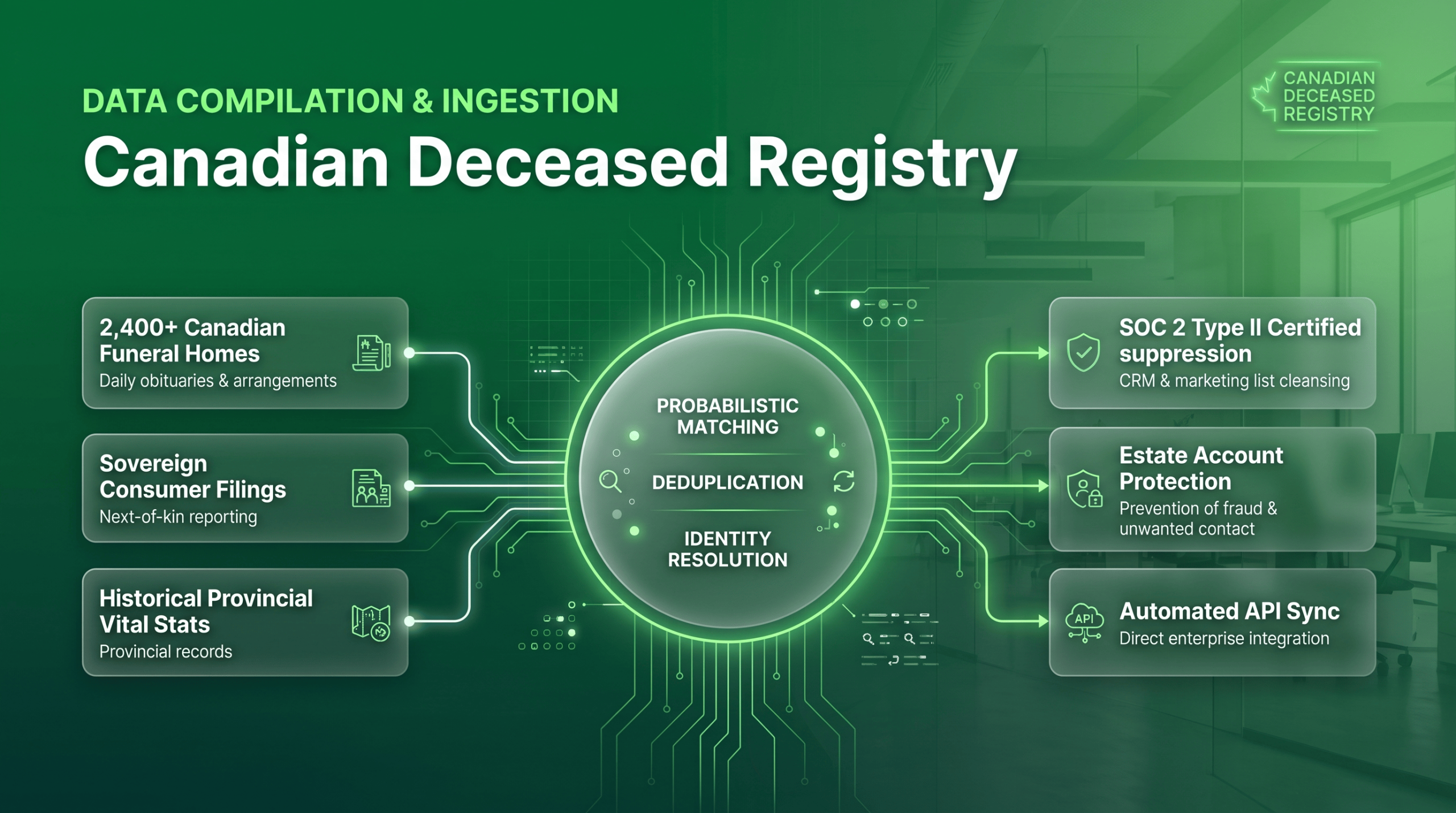
1. Velocity and Primary-Source Coverage
The CDR captures data directly from the front lines of Canadian mortality events: an extensive national network of roughly 2,400 licensed funeral homes, provincial memorial notices, probate announcements, and verified public disclosures. With approximately 1,000 new records processed daily, the CDR captures deaths within days—not months—of their occurrence.
2. Multi-Lingual and Cultural Normalization
Canadian consumer data presents unique structural challenges. The CDR’s deterministic matching algorithms exist specifically for Canadian naming and addressing conventions:
- Normalizing French-Canadian names, compound surnames, and hyphenated patronymics (e.g., Tremblay-Bouchard).
- Resolving variations between official legal names recorded on birth documents and preferred names listed in public memorials.
- Tracking former addresses across inter-provincial moves to ensure there is a match even if an individual moved into a long-term care facility in a different municipality prior to passing.
Architectural Comparison: US vs. Canadian Deceased Screening
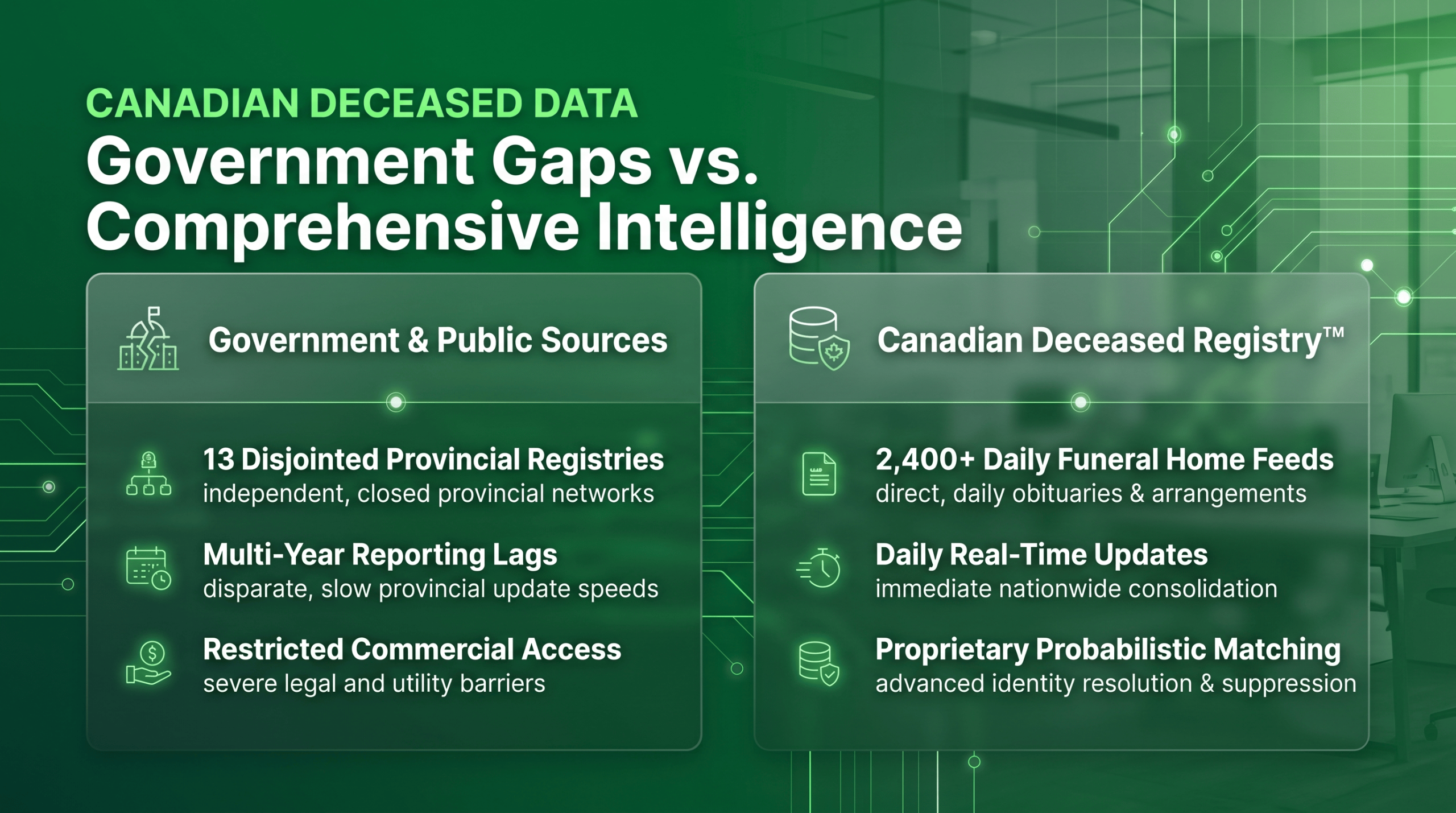
Why Mortality Screening is an Urgent Enterprise Imperative
For Canadian operations leaders, failing to screen files against the CDR introduces acute operational liabilities across three key fronts:
1. Estate Fraud and Synthetic Identity Exploitation
When an individual passes, their social footprint, loyalty accounts, and dormant credit profiles remain active until intentionally shut down. Fraud syndicates actively monitor legacy records to execute pension diversion fraud, loyalty points theft, and account takeovers (ATO). Screening against the CDR allows risk teams to lock compromised accounts before unauthorized transactions clear.
2. Safeguarding Brand Equity and Customer Loyalty
Nothing erodes customer goodwill faster than sending a cheery promotional postcard, high-interest credit offer, or VIP loyalty renewal addressed to someone who died months earlier. Surviving family members routinely share photos of these mailings on social media, sparking public relations backlash that undermines marketing performance.
3. Regulatory and AML/KYC Obligations
Under FINTRAC (Financial Transactions and Reports Analysis Centre of Canada) requirements and Canadian insurance standards, institutions must periodically confirm proof of life and identify deceased policyholders or account owners. Screening against sovereign Canadian data ensures adherence to regulatory obligations without offshore data transfer risks.
Deploy Sovereign Data to Protect Your Enterprise
In Canada, standard address hygiene and US-centric tools leave critical blind spots. Safeguarding customer relationships, preventing estate fraud, and preserving marketing budgets requires a data hygiene strategy built specifically for Canada’s unique legal and demographic framework.
By integrating the Canadian Deceased Registry™ into regular CRM auditing workflows, Canadian organizations ensure their marketing, compliance, and revenue engines operate with precision, empathy, and complete data integrity.
Integrate the Canadian Deceased Registry™ Into Your Data Stack
Cleanlist is Canada’s exclusive provider of the Canadian Deceased Registry™ (CDR), offering the nation’s most comprehensive mortality screening infrastructure:
- Canadian Deceased Registry™ Solutions: Screen your enterprise databases against Canada’s authoritative mortality database, updated daily with roughly 1,000 new records from coast to coast.
- Complimentary Data Health Audit: Run an obligation-free diagnostic of your current customer database to identify deceased records, move decay, and duplicate entries within 24 hours.
- Sovereign, SOC 2 Certified Environment: We process all suppression and verification workflows strictly within Canada, guaranteeing complete PIPEDA compliance and bank-grade data security.