


Clean, validated data improves targeting, personalization, deliverability and ROI, and it keeps you on the right side of Canada’s anti-spam legislation (CASL). Industry research from IBM ties poor data quality to serious financial losses and stalled AI projects. Read on to understand the importance of data hygiene for marketing and to explore the concrete steps that turn that claim into campaign results.
Key Takeaways
Effective data hygiene directly enhances marketing personalization, deliverability, compliance, and AI model performance, resulting in significant cost savings and improved campaign outcomes.
| Point | Details |
|---|---|
| Regular validation | Validate data at entry through form checks, API verification, and enrichment to prevent inaccurate records. |
| Standardize key fields | Use canonical lists for addresses, job titles, and industries to ensure consistency across datasets. |
| Automate deduplication | Implement automated processes to eliminate duplicates and keep data current without manual effort. |
| Integrate suppression lists | Maintain updated opt-outs and deceased registries to improve deliverability and comply with laws. |
| Partner with Cleanlist | We offer validated, campaign-ready data cleaning and ongoing maintenance to maximize targeting accuracy. |
Table of Contents
- What does data hygiene cover in marketing systems?
- Why does data hygiene matter for personalisation and AI readiness?
- How do data hygiene and compliance affect deliverability?
- Which data-quality problems cause the most marketing damage?
- What does a campaign-ready data checklist look like?
- How do you measure the payback from data-hygiene work?
- How often should you clean marketing data?
- Why treat data quality as a performance layer?
- Where can teams get validated, campaign-ready data?
- FAQ
- Sources
What does data hygiene cover in marketing systems?
Data hygiene is the ongoing work of keeping customer and prospect records accurate, complete, consistent, current, deduplicated and normalized. It is a practice, not a one-time project.
The scope reaches every place a marketer stores or activates contact data:
- Your CRM and marketing automation platform
- Customer data platforms and the data warehouse behind them
- Offline lists, event captures and purchased files
- Martech integrations that pass records between all of the above
The day-to-day tasks are familiar: validation at entry, normalization of formats, deduplication, enrichment and suppression of records that should no longer be contacted. Each task protects a different part of the campaign. Validation keeps bad records out, deduplication stops double contact, and suppression protects your reputation. As you can see, the importance of data hygiene for marketing lies everywhere, and is impacted by your actions from planning to delivering your campaigns.
Why does data hygiene matter for personalization and AI readiness?
Personalization only works when the record behind it is right. McKinsey’s research found that successful personalization often drives revenue lifts of 10–15%, with company-specific results spanning 5–25%. That same research makes the dependency plain: scaled personalisation relies on quality data. A wrong first name or a stale address turns a relevant message into a visible mistake.
The direct losses are easy to see. Every duplicate record means a second send, a second print piece or a second paid impression aimed at the same person. Every undeliverable address burns postage or sender reputation. The indirect losses are larger and quieter: skewed audience counts, distorted attribution and budget decisions made on numbers that were never true.
AI raises the stakes. An academic study on machine learning with tabular data found that accuracy, completeness and consistency materially affect model performance, and that polluted training or test data reduces reliability. IBM’s research reports that over a quarter of organisations estimate losses above USD 5 million a year from poor data quality, and that it is a major barrier to moving AI from pilot to production.
Companies that treat data quality as a performance layer pull ahead. A recent analysis in marketing analytics argues that standardisation, categorisation and governance let organisations unlock the value of their analytics investments. While competitors debug their models, these teams are already segmenting more finely and spending more precisely. Partner research on analytics points the same way.
How do data hygiene and compliance affect deliverability?
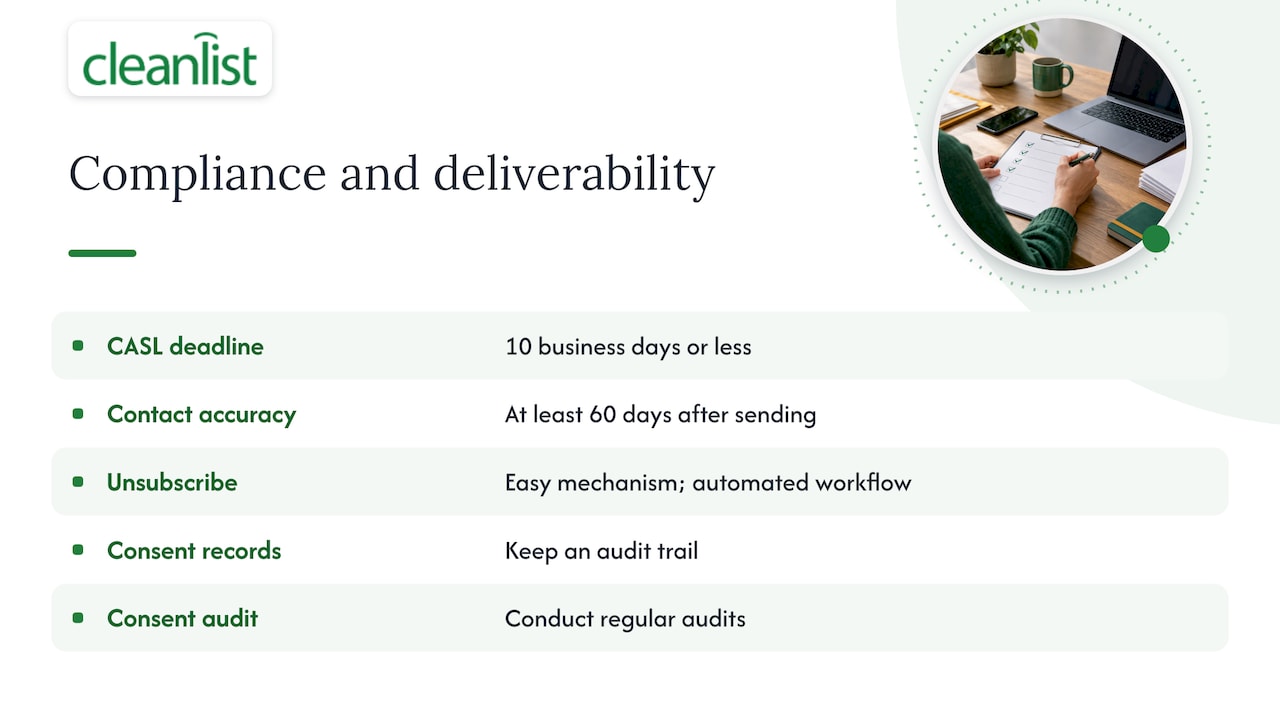
Bad contact data wastes sends and can expose you to legal risk. CASL requires unsubscribe requests to be actioned within 10 business days or less. If your suppression lists lag behind your sending lists, you may expose your business to legal risk.
Consent and personal information also fall under PIPEDA. Government guidance on consent says businesses must consider both laws, keep accurate contact information for at least 60 days after sending and provide an easy unsubscribe mechanism. For a practical walkthrough, see our CASL explainer.
Deliverability follows the same logic. Invalid addresses and ignored opt-outs can harm sender reputation. Useful controls include an audit trail of consent, an automated unsubscribe workflow and a regular consent audit.
Which data-quality problems cause the most marketing damage?
Each common fault maps to a specific campaign failure:
- Duplicate records: inflated audience size, double contact and skewed attribution
- Stale records: people who have moved or died still receive offers, which wastes spend and risks real reputational harm
- Missing or inconsistent fields: segmentation and automation rules break silently
- Siloed identifiers: fragmented customer views and attribution that cannot be trusted
McKinsey’s work on capturing value from customer data notes that many organizations underuse the data they already hold because of silos and legacy systems. The fix starts with seeing which fault is costing you the most, that’s when the importance of data hygiene for marketing starts making real sense and taking tangible shapes in your campaigns.
What does a campaign-ready data checklist look like?
Start with the campaigns that carry the most revenue, then work through these steps in order:
- Validate data as it enters, through form checks, API verification and enrichment at ingestion.
- Standardize key fields, using canonical lists for job titles, industries and addresses.
- Automate deduplication and enrichment so cleanups do not depend on someone remembering.
- Integrate suppression lists, including opt-outs and deceased-registry data.
- Assign clear ownership, with data contracts and service levels for quality.
- Monitor for anomalies and schema drift, and remediate automatically where you can.
- Retrain downstream models after a major clean, so they learn from the corrected records.
Pro Tip: Pick one high-value campaign, clean its audience first and record the before-and-after results. That single comparison becomes your internal case for wider investment.
Our campaign data preparation workflow follows this same sequence for teams that want it handled before a major send.
How do you measure the importance of data hygiene for marketing?
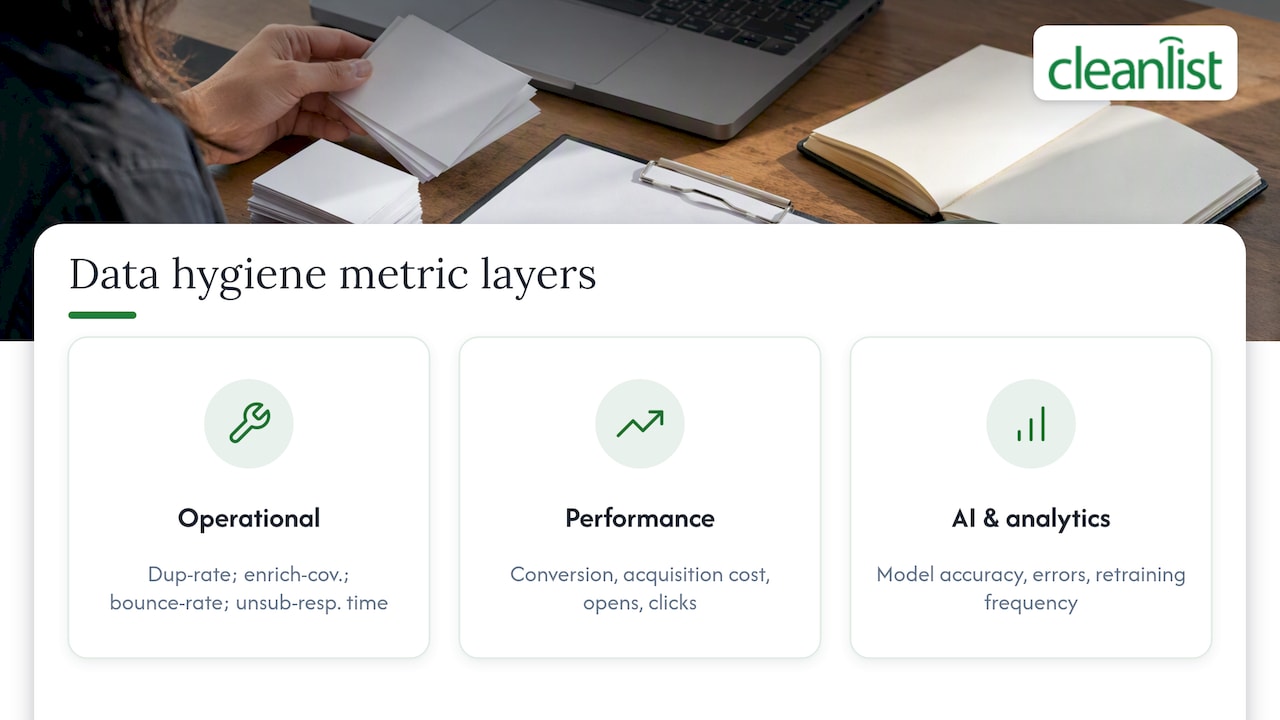
Track three layers of metrics. Operational metrics show the work happening: duplicate rate, enrichment coverage, bounce rate and time-to-action on unsubscribes. Performance metrics show the commercial effect: conversion rate, cost per acquisition, and open and click rates. For AI and analytics, watch model accuracy, error rates and how often models need retraining.
To attribute gains to data work rather than coincidence, run a holdout test. Clean one group within a comparable audience, leave a control group as is, send the same message and compare results. The gap is your measurable lift. Our guide on how enrichment improves marketing ROI covers this logic in more depth.
How often should you clean marketing data?
Split the work into three rhythms. Continuous processes run all the time: validation at entry, unsubscribe handling and real-time deduplication on active channels. Event-driven refreshes happen before a major campaign or a model retraining.
Teams with strong data engineering can run all three in-house. Teams without the capacity often hand the periodic work to a managed service.
Why treat data quality as a performance layer?
I keep seeing the same pattern: a campaign underperforms, the team debates creative and channel mix, and the real cause turns out to be a basic data error nobody checked. That is why I treat data quality as a performance layer rather than an IT chore.
You do not need to fix everything at once. Tie the work to one high-value campaign, prove the lift and expand from there. Cleanlist’s Canadian data capabilities show what operational support for this can look like.
— Jeff
Where can teams get validated, campaign-ready data?
If you would rather not build this capability from scratch, we can help. Our database cleaning and enrichment services validate and enrich your existing records, and our ongoing data maintenance keeps them accurate after the first clean. For major sends, campaign data preparation gets your audience ready before the budget is committed.
The payoff is practical: sharper targeting, less wasted spend and cleaner support for deliverability and compliance. Contact our team to see what a first clean could look like for your database.
FAQ
Why is importance of data hygiene for marketing growing so fast?
Data cleaning removes duplicates, outdated records and formatting errors that waste spend and distort results. It also keeps your outreach aligned with consent and unsubscribe obligations under CASL.
Why does data matter in marketing?
Data tells you who to reach, with what message and through which channel. When it is accurate, personalisation and measurement both improve. When it is not, every downstream decision inherits the error.
What is another word for data hygiene?
Data hygiene is also called data cleansing, data scrubbing or data quality management. The terms overlap, though data hygiene usually implies the ongoing practice rather than a single cleanup.
Why does clean data matter for AI?
Models learn from the records you give them. Research shows that accuracy, completeness and consistency affect machine learning performance, so flawed inputs produce unreliable outputs.
Sources
- Canada’s anti-spam legislation
- Clean before clever: Why data quality is the missing layer in marketing analytics performance
- The effects of data quality on machine learning performance on tabular data | Information Systems
- The value of getting personalization right—or wrong—is multiplying
- The True Cost of Poor Data Quality | IBM