

During the high-stakes holiday retail push, marketers scrutinize every detail of their campaigns. Creative teams spend months refining seasonal messaging, media buyers calculate cost-per-acquisition down to the penny, and merchandising leads optimize promotional discounting to protect margins.
Yet, one systemic oversight regularly triggers PR disasters, public backlash on social media, and emotional distress for grieving families: mailing holiday catalogues, personalized offers, or credit promotions to individuals who have passed away.
For a household mourning the loss of a parent, spouse, or sibling, opening a mailbox in December to find an upbeat, personalized letter that reads, “We miss you, John! Here is an exclusive holiday gift just for you,” is profoundly upsetting. The family’s instinctive reaction is rarely to quietly recycle the flyer. Instead, it sparks customer service escalations, formal complaints, and viral posts on platforms like LinkedIn and Reddit tagging the offending brand.
Ahead of peak retail volume, deceased suppression is not merely a data hygiene task. It is an indispensable brand-protection safeguard and a moral imperative for customer-centric organizations.
The Public and Reputational Toll of an Unsuppressed File
In direct marketing, an undeliverable address costs a retailer the price of print and postage. A deceased record sent to a grieving household costs the brand its reputation.
When an organization fails to clean its customer files of deceased contacts, the repercussions span three distinct operational layers:
1. Brand Equity Destruction & Viral Backlash
Surviving family members often feel insulted by automated marketing messages that suggest an enterprise is careless or insensitive. In an era where consumers readily publish photos of poorly timed mailings to social networks, a single unsuppressed holiday catalogue can cause widespread reputational damage that far outstrips the value of the campaign.
2. Immediate Household Churn
When a deceased consumer receives marketing outreach, the brand doesn’t just lose the individual record; it permanently alienates the surviving family members who manage the household budget. An insensitive mailing guarantees that surviving relatives will cancel their own loyalty accounts, close credit lines, and direct their holiday spending to competitors.
3. Wasted Direct Mail Budget
Direct mail remains one of the most effective holiday conversion channels, but rising print, paper, and postal costs demand fiscal precision. According to Statistics Canada mortality indicators, over 300,000 deaths occur across the country each year. Carrying unsuppressed records on multi-drop holiday campaigns drains significant capital on materials that will never generate a return.
The Canadian Deceased Landscape: Why Standard CRM Checks Fail
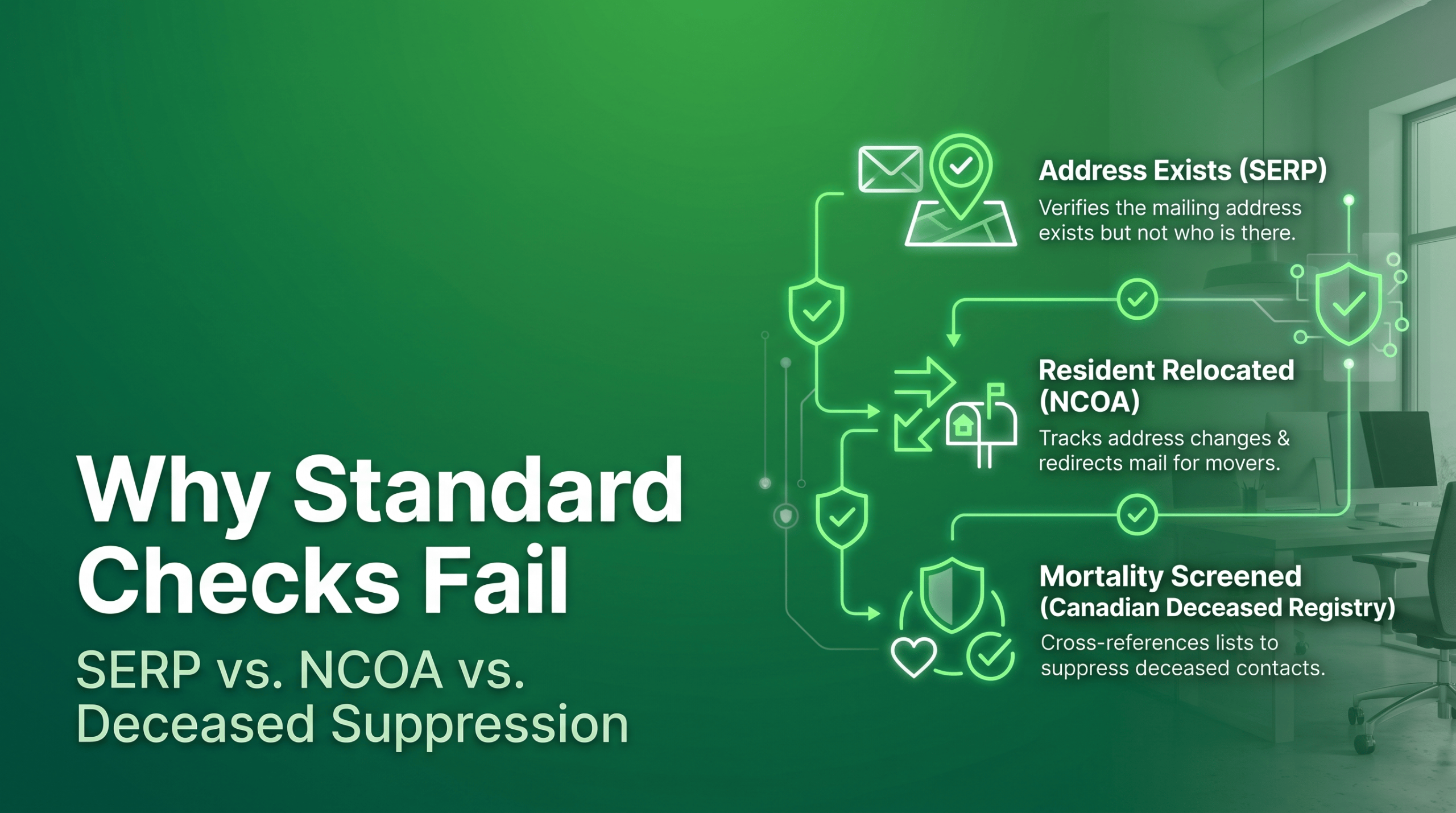
A widespread misconception among retail marketers and CRM administrators is that standard address validation and postal move updates automatically flag deceased individuals.
They do not.
| Data Hygiene Service | Primary Function | Limitations | Critical Blind Spot |
| Canada Post SERP Validation | Verifies that a physical civic address, street name, and postal code match official Canada Post delivery standards. | Only confirms that a structure or delivery point physically exists. | Zero occupancy insight. It cannot verify whether anyone lives there or if the contact is deceased. |
| Canada Post NCOA™ Move Updates | Identifies living individuals and families who have actively registered a move with Canada Post. | Requires an active move filing by an occupant. | Excludes mortality events. Relatives do not file change-of-address notices for deceased family members. |
| Canadian Deceased Registry™ (CDR) Suppression | Cross-references records against nationwide mortality events compiled daily from funeral homes and authoritative sources. | Focused specifically on mortality flags and suppression rather than postal standardization. | None for mortality. Proactively catches deaths before unsuppressed mailings trigger brand damage and distress. |
Relying on standard tools creates critical blind spots due to the unique structure of Canadian records:
1. Canada Has No “Social Security Death Master File”
In the United States, organizations frequently cross-reference the Social Security Administration’s Death Master File (SSDMF). Canada has no equivalent public federal database. Vital statistics are governed provincially, and access is tightly restricted to protect citizen privacy. Without a specialized, compiled registry, Canadian marketers cannot rely on simple public-sector downloads.
2. NCOA™ Does Not Track Mortality
Canada Post’s National Change of Address (NCOA™) registry tracks change-of-address notifications filed by Canadian consumers when relocating. Grieving families do not file change-of-address requests for deceased relatives; they close accounts or leave mail to accumulate. An address can remain perfectly valid according to postal standards long after the resident has passed away.
3. Relatives Rarely Notify Retailers Promptly
When an individual passes, executors prioritize funeral arrangements, estate distribution, life insurance, and legal probate. Contacting retail loyalty programs, department store credit cards, or promotional subscription lists falls to the bottom of the priority list. Unless an enterprise proactively cleanses its files against an authoritative national deceased registry, unmonitored records will persist in the active database for years.
Estate Fraud and Account Takeover Risks in Retail
Beyond the immediate marketing and brand risks, dormant deceased records represent a growing target for criminal activity during peak shopping seasons.
- Loyalty Point Theft: Accumulated retail loyalty points hold clear monetary value. Unmonitored loyalty accounts associated with deceased individuals are prime targets for automated credential stuffing and account takeover (ATO) attacks. Fraudsters deplete balances through gift card redemptions or online checkouts before estates are settled.
- Store-Branded Credit & Financing Fraud: Retailers offering co-branded credit cards or point-of-sale financing must comply with stringent Know Your Customer (KYC) and Anti-Money Laundering (AML) standards. Failing to scrub customer databases against deceased records allows bad actors to exploit synthetic identities or assume deceased profiles to open fraudulent credit lines during chaotic holiday volume spikes.
4-Step Deceased Suppression Protocol for Q4 Campaigns
To protect brand reputation and customer goodwill ahead of peak season, marketing operations and RevOps teams should implement a strict pre-flight suppression workflow:
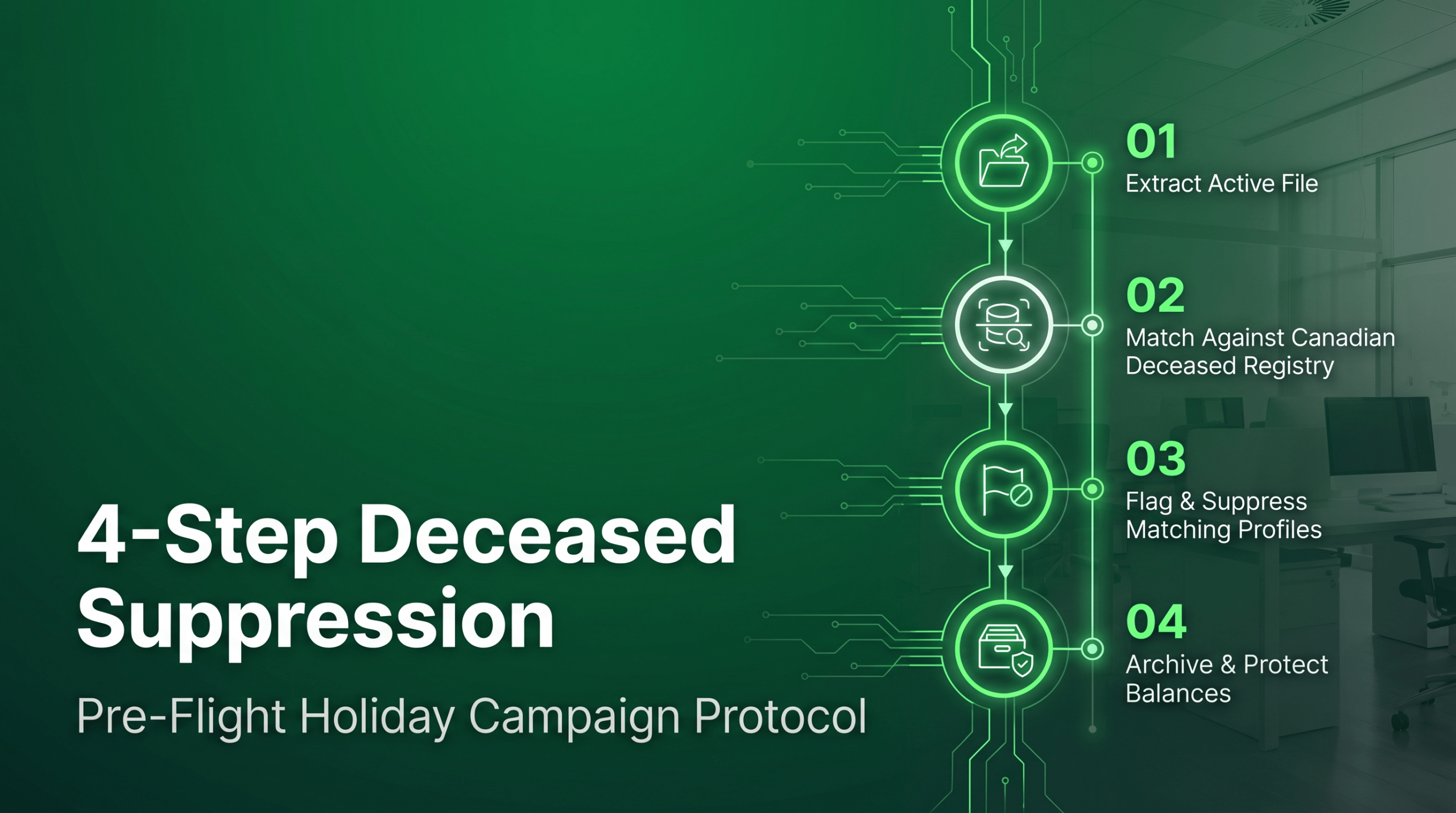
- Audit All Outbound Marketing Streams: Deceased suppression must not be limited to print catalogues. Ensure digital custom audience lists (Meta, Google Customer Match) and automated holiday win-back email workflows are scrubbed against verified deceased registries.
- Screen Against the Canadian Deceased Registry™ (CDR): Run files against Canada’s only national, verified database of deceased citizens—compiled daily from roughly 2,400 Canadian funeral homes and proprietary authoritative sources to catch recent mortality events.
- Automate CRM Suppression Flags: Rather than hard-deleting records (which destroys historical purchase reporting), apply an automated suppression tag in your CRM. This preserves transaction history for financial reporting while permanently halting automated communication.
- Lock Associated Loyalty and Credit Balances: Restrict online redemption workflows for confirmed deceased profiles to shield the customer’s estate and your organization from fraudulent holiday balance drainage.
Marketing with Empathy and Precision
Delivering effective holiday campaigns requires more than enticing discounts and polished creative; it demands genuine respect for the people on the receiving end.
By integrating proactive deceased suppression into your pre-campaign data hygiene checklist, your organization eliminates offensive blunders, guards against account fraud, and ensures your holiday marketing dollars reach active, engaged Canadian households.
Protect Your Brand Integrity This Holiday Season
Cleanlist is the exclusive national distributor of the Canadian Deceased Registry™ (CDR), providing the country’s most comprehensive and up-to-date mortality screening engine:
- Canadian Deceased Registry™ Screening: Screen your customer databases against Canada’s authoritative national deceased database, updated daily with approximately 1,000 new records from coast to coast.
- Complimentary Data Health Audit: Discover how many moved, invalid, or deceased records are currently sitting in your active marketing files with an obligation-free 24-hour audit.
- Secure, Made-in-Canada Data Processing: All data hygiene, deduplication, and suppression services are processed securely within Canada under SOC 2 Type II certified governance, safeguarding complete PIPEDA compliance.