


During the peak retail surge between Black Friday, Cyber Monday, and Boxing Day, Canadian marketers execute synchronized omnichannel strategies. Direct mail catalogues, VIP early-access postcards, and personalized flyers land in physical mailboxes, while identical audience segments see matched product carousels across Meta, Google Customer Match, and programmatic display.
The strategy is sound: high-value households that receive both physical and digital touches convert at significantly higher rates than single-channel audiences.
However, both channels share a single point of failure: the underlying customer database.
When an enterprise customer relationship management (CRM) database suffers from stale addresses, duplicate records, and invalid contact data, the financial fallout is not confined to a single department. It creates a compounding drain across both physical and digital budgets simultaneously. Direct mail burns money on unrecoverable print, paper, and postage, while paid digital teams quietly burn programmatic ad spend on low match rates, dormant profiles, and distorted frequency caps.
To protect peak Q4 campaign returns, retailers must understand how dirty lists sabotage both sides of the marketing ledger—and why a unified pre-campaign data scrub delivers immediate, compounding ROI.
The Physical Drain: How Stale Data Crushes Direct Mail Margins
Direct mail remains a dependable conversion driver during the holidays, but rising paper costs and postal rates leave no margin for list decay.
According to demographic mobility data from Statistics Canada, over one-third (35%) of Canadian households move within a five-year period, representing well over one million domestic moves each year. If a retailer’s customer file has not been audited since the previous holiday season, roughly 10% to 12% of the mailing list no longer lives at the recorded address.

When uncleaned customer files are sent to the commercial print house, three points of physical waste occur:
1. Delivery to the Wrong Household
When a catalogue is delivered to a customer’s previous residence, the current occupant rarely passes it along. For targeted VIP incentives or loyalty-tiered gift certificates, this creates privacy exposure under the Personal Information Protection and Electronic Documents Act (PIPEDA) while leaving the actual high-value customer completely unaware of the promotion.
2. Duplicate Household Mailings
Name entry discrepancies—such as Robert Smith vs. Rob Smith or 123 Main St W vs. 123 Main Street West, Apt 4—cause commercial print workflows to generate two or three identical mail pieces for a single household. This doubles or triples the cost to reach a single decision-maker while making the retailer appear operationally disjointed.
3. Forfeited Canada Post Incentive Rates
To qualify for Canada Post automated machine-sort discounts (such as Personalized Mail™ incentive rates), addresses must pass official Software Evaluation and Recognition Program (SERP) validation. Non-standardized addresses drop out of the discount qualification pool, inflating per-piece postage costs across the entire batch.
The Digital Leak: The Hidden Cost of Dirty CRM Lists in Ad Retargeting
While physical mail waste is visible in warehouse scrap piles and carrier invoices, digital waste is silent. It hides inside blended reporting metrics and degraded algorithm performance.
Modern digital ad platforms—including Meta Ads Manager, Google Customer Match, and TikTok Ads—rely on first-party CRM lists to build custom audiences and high-intent lookalike models. These platforms hash customer data points (email address, mobile phone number, civic address, and postal code) and match them against registered user accounts.
When an uncleaned CRM list is uploaded, performance degrades across three distinct vectors:
1. Sub-50% Platform Match Rates
An uncleaned retail list frequently yields match rates below 45% on Meta and Google. If an uploaded segment of 100,000 historical buyers only matches 42,000 active platform users, the campaign’s total addressable audience is cut by more than half before bidding begins. The retailer’s acquisition engine is forced to fall back on broad, expensive contextual targeting to compensate for lost scale.
2. Wasted CPMs on Abandoned Accounts
Consumers regularly abandon old secondary email addresses or switch primary email providers. When ad algorithms attempt to deliver impressions against historical email handles that are checked infrequently, brands burn high peak-season CPMs bidding for visibility across ghost accounts.
3. Profile Fragmentation and Ad Burnout
Just as duplicate records trigger multiple direct mail pieces, duplicate CRM records create fractured digital profiles. A single consumer might exist three times in an enterprise database: under a personal email, a work email, and an older e-commerce guest checkout profile. Instead of respecting an optimal frequency cap of three to four impressions per week, the ad platform treats them as three distinct users—bombarding the shopper with excessive impressions, driving ad fatigue, and inflating the merchant’s blended customer acquisition cost (CAC).
The Compounding Math: A Comparative Omnichannel Model
To illustrate how list decay damages campaign economics, consider an omnichannel Canadian retailer deploying a holiday campaign across a 100,000-customer historical segment.
The campaign budget allocates $1.15 per piece for a targeted physical catalogue drop alongside a synchronized $25,000 custom audience retargeting spend across Meta and Google.
| Campaign Expense Category | Uncleaned Customer File (Standard Decay) | Cleaned & Synchronized File (Pre-Flight Audit) | Net Operational Variance |
| Direct Mail List Size | 100,000 records | 85,300 verified, deduplicated households | 14,700 wasted units eliminated |
| Mover & Undeliverable Rate | ~11.0% moved (11,000 units) | < 0.5% (NCOA™ updated to current address) | 10,500 active customers recaptured |
| Household Duplicate Rate | 3.7% duplicates (3,700 wasted units) | 0.0% (Automated household deduplication) | $4,255 in duplicate print/postage saved |
| Direct Mail Spend Burn | $16,905 burned on bad doors & duplicates | $0 burned (Budget concentrated on live buyers) | +$16,905 saved or redeployed |
| Digital Audience Match Rate | 43% match (43,000 addressable profiles) | 71% match (Validated phone, email, & address) | +28,000 more reachable VIP buyers |
| Digital Media Efficiency | High CPM waste on dormant profiles & duplicates | Optimal frequency capping & precision retargeting | Up to 25% lower blended CAC |
| Total Measurable Waste | $23,000+ in lost media spend and print scrap | Zero unrecoverable budget waste | Direct margin protection |
Cleaning the file once prevents over $16,000 in physical mail waste while expanding the reach of the digital retargeting campaign by tens of thousands of active buyers.
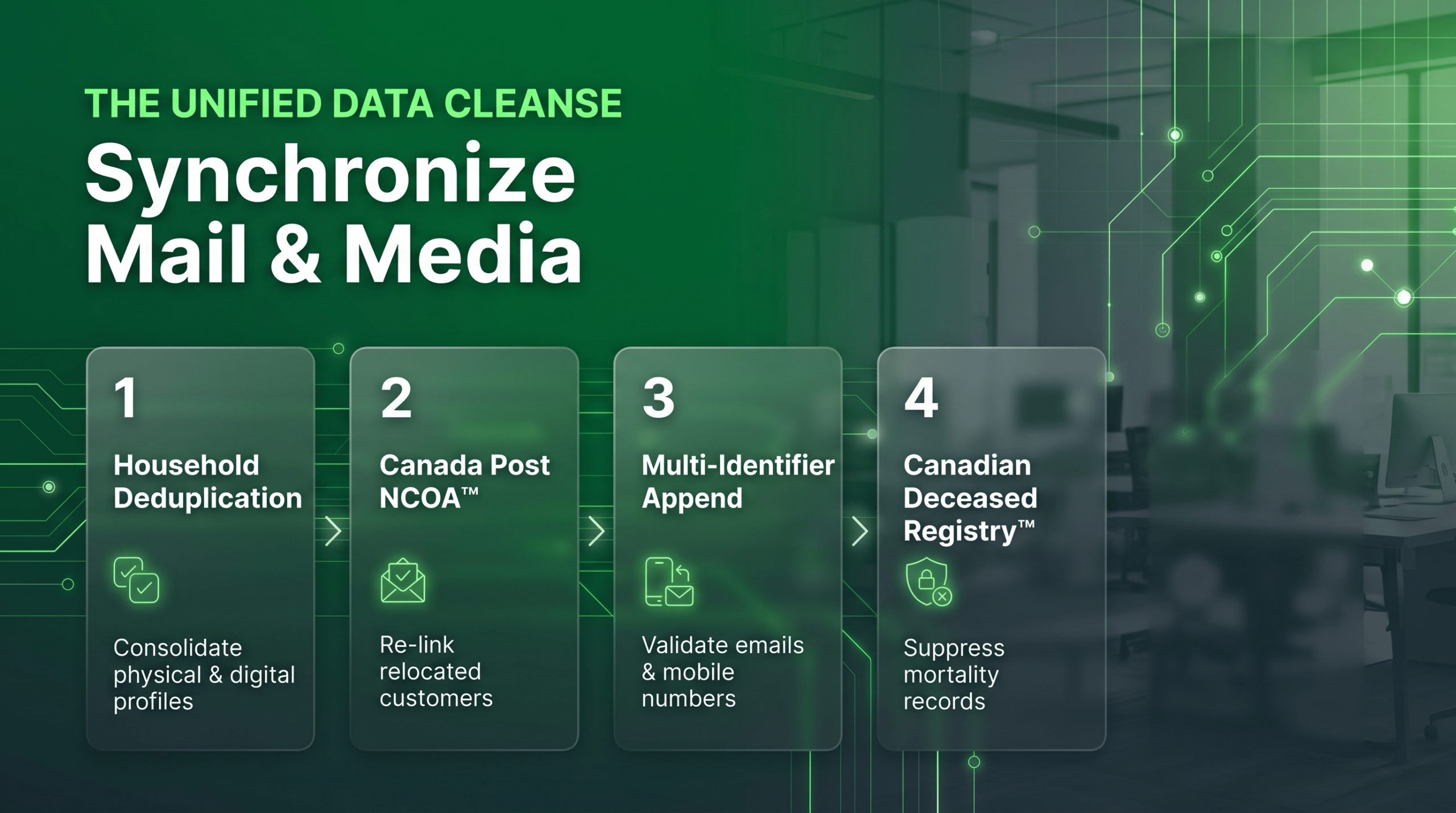
The Unified Cleanse: 4 Steps to Synchronize Mail & Media Before Q4 Launch
Marketing operations and CRM teams should implement this four-step synchronization protocol at least 30 days prior to their holiday campaign drop:
- Household-Level Deduplication: Normalize customer records using standardized street formatting and phone identifiers. Merge fragmented purchase histories into a single Golden Record, eliminating multi-catalogue deliveries and coordinating digital frequency caps across platforms.
- Canada Post NCOA™ Move Updating: Screen customer databases against Canada Post’s National Change of Address (NCOA™) Mover Data. NCOA™ processing re-links relocated Canadian consumers to their current civic addresses, ensuring catalogues follow buyers to their new homes while feeding accurate geographic signals into ad platforms.
- Multi-Identifier Verification and Append: Validate email syntax to reduce bounce rates, remove invalid domains, and append verified mobile phone numbers. Supplying ad platform hashing algorithms with three verified identifiers (email, mobile phone, and physical postal code) increases customer match rates from sub-50% to over 70%.
- Canadian Deceased Registry™ (CDR) Suppression: Ensure both direct mail files and digital exclusion lists are cross-referenced against the Canadian Deceased Registry™. This prevents distressing mailings from reaching grieving families and stops ad spend from targeting unmonitored digital profiles.
Maximize Peak Season Campaign Velocity
In peak retail, customer acquisition cost spikes as competitors saturate both physical mailboxes and digital feeds. You cannot afford to deploy high-value marketing investments against decaying customer data.
By treating data hygiene as a foundational media multiplier rather than a back-office administrative task, Canadian omnichannel marketers protect their direct mail margins, boost digital retargeting performance, and drive higher holiday revenue.
Synchronize Your Physical and Digital Marketing Data Today
Cleanlist is Canada’s largest provider of customer data hygiene, address verification, and database enrichment services:
- Canada Post NCOA™ Processing: Update relocating customers automatically using official Canada Post mover databases spanning six years of domestic moves.
- Complimentary Data Health Audit: Upload your customer segment for an obligation-free 24-hour audit revealing exact move counts, duplicate rates, and deliverability scores.
- Customer Data Cleaning & Deduplication: Merge fragmented profiles, standardize addresses to Canada Post SERP standards, and maximize both postal discounts and ad platform match rates.