






Each month, Cleanlist tracks both newly registered and closed Canadian businesses. Together, these metrics provide a clear view of business churn — and the real operating environment facing Canadian entrepreneurs and the brands that sell to them.
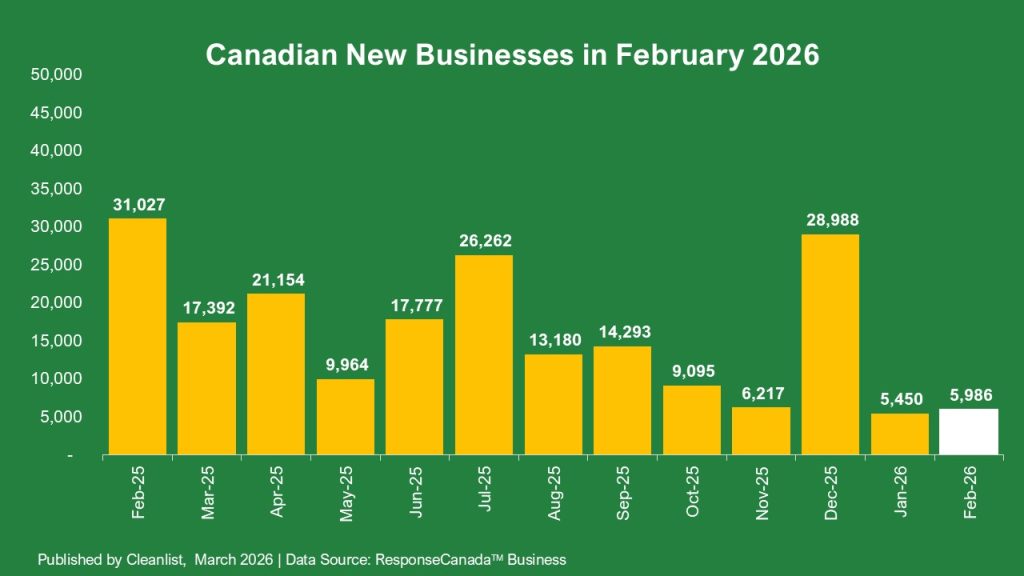
After January’s sharp year-start slowdown, February shows modest stabilization in formations — but a dramatic spike in closures.
📊 February 2026 Snapshot
In February 2026, Cleanlist identified:
5,986 new businesses
73,421 business closures
This results in a net decline of 67,435 businesses nationwide.
Compared to January 2026:
New businesses ▲ 10% month-over-month (vs. 5,450)
Closures ▲ 739% month-over-month (vs. 8,754)
Net contraction widened significantly
While new business creation improved slightly, the closure spike materially altered the business churn landscape.
Why February Looks So Volatile
Formation activity appears to be stabilizing at a low baseline.
Closures, however, show strong seasonal distortion.
Historically, early-year months often reflect:
Administrative dissolutions processed after year-end
Delayed shutdown filings
Tax-driven corporate clean-up activity
Formal closures of businesses that effectively stopped operating in late 2025
This creates periods where closures surge even if underlying economic conditions haven’t shifted dramatically month-to-month.
What This Means for Business Churn?
February’s data reinforces several realities:
- Business creation remains structurally muted
- Closure activity remains episodic but elevated
- Net expansion remains difficult to sustain
Canada continues to operate in a high-churn environment, where new formation does not consistently offset exits.
For companies selling into the SME market, this means the addressable universe is constantly turning over.
Why This Matters for Marketers and Sales Teams
In a volatile churn environment:
Speed becomes strategic.
Newly formed businesses:
- Are actively selecting vendors
- Make foundational purchasing decisions quickly
- Lock in early supplier relationships
At the same time, elevated closures mean:
- Legacy prospect lists decay faster
- Ongoing database hygiene is critical
- Sales targeting must prioritize active entities
When churn increases, clean and current business data becomes a competitive advantage.
The Cleanlist Takeaway
February does not show a formation rebound — it shows stabilization at a low level while closures spike sharply.
For teams targeting Canadian businesses in 2026:
- Precision targeting matters more than scale
- Immediate outreach post-formation is essential
- Suppression of closed businesses is critical to protect ROI
Understanding churn is not optional — it is foundational to accurate pipeline building.
The opportunity is not just knowing how many businesses are created — it’s knowing which ones are still operating, and reaching them first.
🔍Want to Reach Canada’s Newest Businesses?
Cleanlist offers free self-service counts to help you size the opportunity. See our business data page for more information and links.