


Customer data integrity is the assurance that customer information remains accurate, consistent, reliable, and unaltered by unauthorized changes throughout its entire lifecycle. For marketing professionals and data analysts, this is not a technical nicety. It is the foundation of every campaign decision, every customer segment, and every revenue forecast your team produces.
Poor data quality is the top challenge for 64% of organizations trying to maintain data integrity, and 67% lack full trust in their data for decision-making. When your customer records are wrong, your marketing dollars work against you instead of for you.
What is customer data integrity and why does it matter?
Customer data integrity is defined by four core attributes: accuracy, consistency, completeness, and validity. Accuracy means a value reflects the real world. Consistency means the same customer record shows the same information across every system that holds it. Completeness means no critical fields are missing. Validity means data conforms to the rules your business has defined, such as a postal code that matches a province.
Data integrity differs from two related concepts that marketers often conflate with it. Data integrity and data security are not the same thing. Security protects data from unauthorized access. Integrity guarantees that data has not been altered, accidentally or deliberately, across systems and time. Data quality, meanwhile, measures fitness for a specific purpose. Integrity is the broader promise: trustworthiness over the entire lifecycle.
Consider a CRM record for a customer who moved from Toronto to Calgary two years ago. If your email platform still shows the Toronto address, your direct mail goes to the wrong province, your regional segmentation is wrong, and your analytics misattribute campaign results. That is a data integrity failure, not a security breach. Integrity is the OUTCOME of database cleaning and enrichment in Canada.
And if that customer has since passed away, continuing to mail or bill them is both wasteful and damaging to your brand. Confirming who is still living and still resident is exactly what identity and life verification does.

Pro Tip: Treat data integrity as a continuous process, not a project. A one-time data cleanse fixes yesterday’s problems. Only ongoing validation prevents tomorrow’s.
Key dimensions of customer data integrity
- Accuracy: The value matches the real-world entity. A customer’s email address either works or it does not.
- Consistency: The same customer record is synchronized across your CRM, email platform, and analytics warehouse without conflict.
- Completeness: Required fields are populated. A record missing a phone number or postal code is incomplete by definition.
- Validity: Data conforms to defined formats and business rules. A date of birth entered as “99/99/9999” fails validity instantly.
- Timeliness: Data reflects the current state of the customer. A record that was accurate 18 months ago may be misleading today.
- Verifiability: You can confirm an address record against an authoritative source, that the person is still living, and still lives at the address on file.
What are the main challenges that undermine customer data integrity?
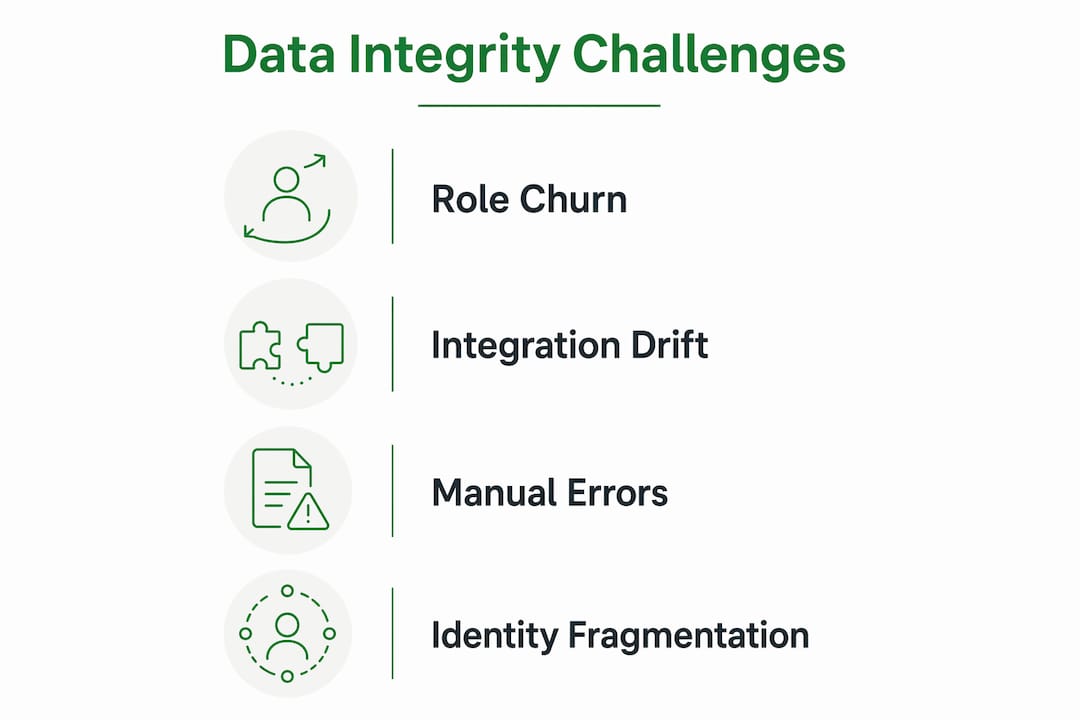
CRM data quality decays through four primary causes: role churn, integration drift, manual entry fatigue, and identity fragmentation. Each one quietly erodes the reliability of your customer database without triggering any alert.
- Role churn: Contacts change jobs. A B2B record tied to a specific person at a company becomes stale the moment that person leaves. Without automated updates, your sales team is calling ghosts.
- Integration drift: When two systems are connected and one is updated without the other, records diverge. A customer who updates their address in your e-commerce platform may still show the old address in your CRM six months later.
- Manual entry fatigue: Sales reps and customer service agents entering data under time pressure make mistakes. Duplicate records, misspelled names, and missing fields accumulate faster than any audit can catch them.
- Identity fragmentation: The same customer exists as multiple records across systems, each with slightly different information. Merging them correctly requires governance, not just software.
“Lack of trust in data leads to wasted time on manual reconciliation and slows down operations.” — Domo
Data integrity failures cause poor decisions, operational disruption, and financial and compliance risks. For British firms, data breaches tied to integrity failures averaged £3.4 million in financial impact as of 2026. Canadian enterprises face equivalent exposure under PIPEDA and provincial privacy legislation. The cost is not hypothetical.
How do best practices and technology support data integrity?
Maintaining data integrity improves team collaboration and speeds strategic decision-making, and it enables effective AI deployment. AI models trained on corrupt or inconsistent data produce unreliable outputs. The best practices below address both the human and technical sides of the problem.
- Continuous data cleansing: Schedule automated validation checks at regular intervals rather than waiting for a problem to surface. Tools like Salesforce Data Quality, Informatica, and Cleanlist’s data cleansing services run checks against authoritative reference data to flag and correct errors before they compound.
- Golden record ownership: Assign a single authoritative version of each customer record, known as a golden record, and define which system owns it. Every other system reads from that record rather than maintaining its own copy.
- Event-driven updates: Trigger record updates based on real-world events, such as a customer completing a purchase, updating their profile, or changing their email address. Waiting for a scheduled batch update creates windows of inaccuracy.
- AI-driven monitoring: Automated testing and AI-driven tools verify data integrity at scale, detecting unauthorized changes and inconsistencies that manual audits miss entirely.
Pro Tip: Build data validation into your intake forms and API connections. Catching a bad record at the point of entry costs a fraction of what it costs to clean it up downstream.
Technology comparison: approaches to data integrity
| Approach | Best for | Key limitation |
|---|---|---|
| Batch cleansing | Periodic database refreshes | Creates gaps between clean cycles |
| Real-time validation | High-volume transactional data | Requires strong API architecture |
| AI-driven monitoring | Detecting anomalies at scale | Needs clean baseline data to train on |
| Third-party enrichment | Filling gaps and verifying records | Dependent on source data freshness |
Cleanlist covers Canadian marketing teams specifically with data on over 18 million households and 3 million businesses. That scale of reference data makes household-level accuracy achievable for enterprise campaigns in a way that generic global tools cannot match.
What strategic approaches ensure long-term data integrity?
Data cleanup and unification to create a master customer dataset is a long-term project that typically spans 12–24 months. Marketing teams that treat it as a quick fix consistently underestimate the scope. The table below maps the phases most organizations move through.
| Phase | Activity | Typical duration |
|---|---|---|
| Assessment | Audit existing records, identify duplicates and gaps | 1–3 months |
| Standardisation | Align field definitions across marketing, sales, and finance | 2–4 months |
| Cleansing | Remove duplicates, correct errors, fill gaps with data enrichment | 3–6 months |
| Governance setup | Define ownership, update workflows, and assign golden records | 2–4 months |
| Ongoing monitoring | Continuous validation, scheduled audits, and AI-driven checks | Ongoing |
CRM systems alone are insufficient as Master Data Management solutions. A CRM is a system of action. It records what your team does with customers. It is not designed to be the single source of truth for customer identity across your entire organization. Proper Master Data Management requires governance frameworks, integration across systems, and defined ownership that sits outside any single application.
Proper customer data management and data enrichment service require aligned definitions among marketing, sales, service, and finance teams. When each function defines “customer” differently, the master dataset fractures. A governance body with representatives from each function resolves conflicts before they corrupt records. Regular audits, at minimum quarterly, catch drift before it becomes a crisis.
Standardising data entry processes is the least glamorous and most effective control available. Dropdown menus, address validation at point of entry, and mandatory field rules prevent the majority of manual entry errors before they reach your database.
Key takeaways
Customer data integrity requires continuous validation, cross-functional governance, and authoritative reference data to remain trustworthy across every system and decision.
| Point | Details |
|---|---|
| Core definition | Integrity means data stays accurate, consistent, complete, and valid across its entire lifecycle. |
| Top challenge | 64% of organizations cite poor data quality as their biggest integrity obstacle. |
| CRM is not enough | CRMs are systems of action, not Master Data Management solutions; governance is required. |
| Long-term commitment | Full data unification typically takes 12–24 months and requires cross-functional alignment. |
| Prevention beats correction | Validating data at the point of entry costs far less than cleaning corrupt records downstream. |
Why I think most teams are solving the wrong data problem
Most marketing teams I have worked with treat data integrity as a cleanup task. They schedule a cleanse, fix the obvious errors, and move on. Six months later, the same problems are back. The real issue is not dirty data. It is the absence of a system that keeps data clean continuously.
The blind spot I see most often is the assumption that a CRM integration solves the problem. It does not. CRM data requires governance, event-driven updates, and ownership to prevent decay and identity fragmentation. Without those controls, every new integration you add is another source of drift.
The teams that get this right share one trait: they treat data integrity as a shared responsibility across marketing, IT, and analytics. No single team owns it. All three are accountable for it. That shift in ownership changes how quickly problems get caught and fixed.
The future pressure point is AI. Every AI-driven personalization tool, every predictive model, and every automated campaign depends on the quality of the data it consumes. Teams that invest in data integrity now are building the infrastructure that makes AI actually work. Teams that do not are building expensive systems on unstable ground.
How Cleanlist supports customer data accuracy for Canadian marketers
Cleanlist is built specifically for the Canadian market, with coverage of over 18 million households and 3 million businesses. That depth of reference data means your customer records can be validated, corrected, and enriched against one of the most current national datasets available.
Beyond cleaning and enrichment, Cleanlist can verify residency and proof of life, and flag deceased records, so you stop contacting people who have moved or passed away.
If your team is dealing with duplicate records, outdated addresses, or gaps in your customer profiles, Cleanlist’s data cleansing and enrichment services address those problems at the source. For teams ready to go further, the database spring cleaning guide walks through a practical process for refreshing your entire customer list. And if you want to understand how cleaner data translates to better campaign returns, the data enrichment and marketing ROI resource makes that case with specifics. Your marketing dollars work harder when the data behind them is right.
Get Free Data Discovery Report here.
FAQ
What is customer data integrity in simple terms?
Customer data integrity means your customer records are accurate, consistent, complete, and unchanged by unauthorized modifications across every system that holds them. It is the guarantee that the data you act on reflects reality.
How does data integrity differ from data quality?
Data accuracy asks whether a value is correct at one point in time. Data integrity ensures that correctness persists across systems and over time. Data quality measures whether data is fit for a specific purpose.
What causes customer data to lose integrity over time?
The four main causes are role churn, integration drift, manual entry errors, and identity fragmentation. Each one introduces inaccuracies that compound if no continuous validation system is in place.
Is a CRM system enough to maintain data integrity?
A CRM is a system of action, not a Master Data Management solution. Maintaining integrity requires governance frameworks, golden record ownership, and integration controls that go beyond what any CRM provides on its own.
How long does it take to restore customer data integrity?
Full data unification and cleanup typically takes 12–24 months for most organizations. The timeline depends on the number of systems involved, the volume of records, and the maturity of existing governance processes.